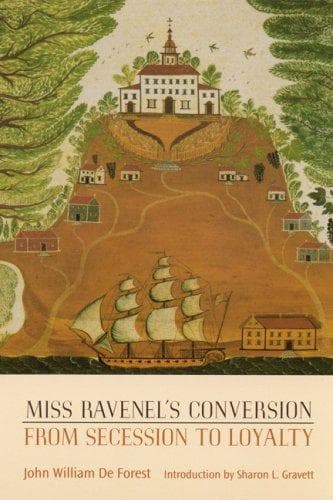
Miss Ravenel's conversion from secession to loyaltyDe Forest, John William
History
Miss Ravenel's conversion from secession to loyalty
De Forest, John William
Historical fiction; United States -- History -- Civil War, 1861-1865 -- Fiction; War stories; Women -- United States -- Fiction
The settlement of his mother's estate and of his own pecuniary affairs
occupied Colburne's time until the early part of October. By then he had
invested his property as well as might be, rented the much-loved old
homestead, taken a room in the New Boston House, and was fully prepared
to bid good-bye to native soil, and, if need be, to life. Miss Ravenel
was a strong though silent temptation to remain and to exist, but he
resisted her with the heroism which he subsequently exhibited in
combating male rebels.
One morning, as he left the hotel rather later than usual to go to his
office, his eyes fell upon a high-colored face and gigantic brown
mustache, which he could not have failed to recognize, no matter where
nor when encountered. There was the wounded captive of Bull Run, as big
chested and rich complexioned, as audacious in eye and haughty in air,
as if no hurt nor hardship nor calamity had ever befallen him. He
checked Colburne's eager advance with a cold stare, and passed him
without speaking. But the young fellow hardly had time to color at this
rebuff, when, just as he was opening the outer door, a baritone voice
arrested him with a ringing, "Look here!"
"Beg pardon," continued the Lieutenant-Colonel, coming up hastily.
"Didn't recognize you. It's quite a time since our pic-nic, you know."
Here he showed a broad grin, and presently burst out laughing, as much
amused at the past as if it did not contain Bull Run.
"What a jolly old pic-nic that was!" he went on. "I have shouted a
hundred times to think of myself passing the wine and segars to those
prim old virgins. Just as though I had bowsed into the House Beautiful,
among Bunyan's damsels, and offered to treat the crowd!"
Again the Lieutenant-Colonel laughed noisily, his insolent black eyes
twinkling with merriment. Colburne looked at him and listened to him
with amazement. Here was a man who had lately been in what was to him
the terrible mystery of battle; who had fallen down wounded and been
carried away captive while fighting heroically for the noblest of
causes; who had witnessed the greatest and most humiliating overthrow
which ever befel the armies of the republic; who yet did not allude to
any of these things, nor apparently think of them, but could chat and
laugh about a pic-nic. Was it treasonable indifference, or levity, or
the sublimity of modesty? Colburne thought that if _he_ had been at Bull
Run, he never could have talked of any thing else.
"Well, how are you?" demanded Carter. "You are looking a little pale and
thin, it seems to me."
"Oh, I am well enough," answered Colburne, passing over that subject
with modest contempt, as not worthy of mention. "But how are _you_? Have
you recovered from your wound?"
"Wound? Oh! yes; mere bagatelle; healed up some time ago. I shouldn't
have been caught if I hadn't been stunned by my horse falling. The wound
was nothing."
"But you must have suffered in your confinement," said Colburne,
determined to appreciate and pity.
Public-domain text, read in full here on John Shaqi.
Reviews
Reviews
No reviews yet
Be the first to share your thoughts on this work.
Join the Discussion
Join the discussion
Sign in to leave a comment or review.
Sign InorCreate an account