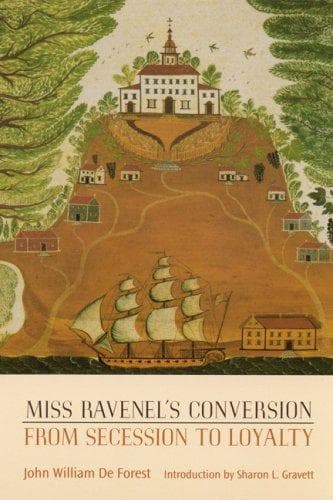
Miss Ravenel's conversion from secession to loyaltyDe Forest, John William
History
Miss Ravenel's conversion from secession to loyalty
De Forest, John William
Historical fiction; United States -- History -- Civil War, 1861-1865 -- Fiction; War stories; Women -- United States -- Fiction
"How rapidly times change!" he said to Colburne in a moment of unusual
communicativeness. "Three years ago I expected to take a regiment or so
across this gulf on a very different errand. I was, by (this and that) a
filibuster and pro-slavery champion in those days; at least by
intention. I was closeted with the Lamars and the Soules--the Governor
of South Carolina and the Governor of Mississippi and the Governor of
Louisiana--the gentlemen who proposed to carry the auction-block of
freedom into Yucatan, Cuba, the island of Atalantis, and the moon. I
expected to be a second Cortez. Not that I cared much about their
pro-slavery projects and palaverings. I was a soldier of fortune, only
anxious for active service, pay and promotion. I might have been monarch
of all I surveyed by this time, if the world had turned as we expected.
But this war broke up my prospects. They saw it coming, and decided that
they must husband their resources for it. It was necessary to take sides
for a greater struggle than the one we wanted. They chose their party,
and I chose mine."
These confessions were too fragmentary and guarded to satisfy the
curiosity of Colburne; but he subsequently obtained information in the
South from which he was able to piece out this part of Carter's history;
and the facts are perhaps worth repeating as illustrative of the man and
his times. Our knowledge is sufficiently complete to enable us to decide
that the part which he played in the filibustering conspiracy was not
that of a Burr, but of a Walker, which indeed might be inferred from the
fact that he was not intellectually capable of making himself head of a
cabal which included some of the cleverest of the keen-sighted (though
not far-sighted) statesmen of the south. It is no special reflection on
the Colonel's brains to say that they were not equal to those of Soule
and Jefferson Davis. Moreover a soldier is usually a poor intriguer,
because his profession rarely leads him to appeal to any other influence
than open authority: he is not obliged to learn the politician's
essential arts of convincing, wheedling and circumventing; he simply
says to his man Go, and he goeth. Carter, then, was to be the commander
of the regiment, or brigade, or division, or whatever might be the
proposed force of armed filibusters. There appears to have been no doubt
in the minds of the ringleaders as to his fidelity. He was a Virginian
born, and of a family which sat in the upper seats of the southern
oligarchy. Furthermore, he had married a wife and certain appertaining
human property in Louisiana; and although he had buried the first, and
dissolved the second (as Cleopatra did pearls) in the wine cup, it was
reasonable to suppose that they had exercised an establishing influence
on his character; for what Yankee even was ever known to remain an
abolitionist after having once tasted the pleasure of living by the
labor of others? Moreover he had become agent and honorary stockholder
Public-domain text, read in full here on John Shaqi.
Reviews
Reviews
No reviews yet
Be the first to share your thoughts on this work.
Elsewhere in the archive
Join the Discussion
Join the discussion
Sign in to leave a comment or review.
Sign InorCreate an account