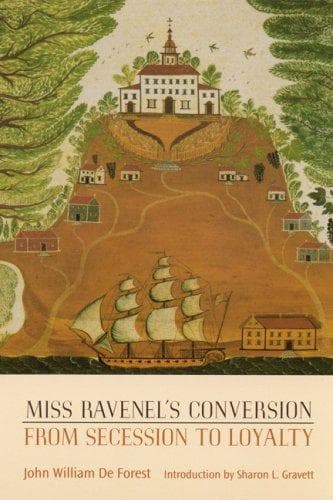
Miss Ravenel's conversion from secession to loyaltyDe Forest, John William
History
Miss Ravenel's conversion from secession to loyalty
De Forest, John William
Historical fiction; United States -- History -- Civil War, 1861-1865 -- Fiction; War stories; Women -- United States -- Fiction
of a company which had a new patent rifle to dispose of; and it was an
item of the filibustering bargain that the expeditionary force should
be armed with ordnance furnished by this Pennsylvania manufactory.
Finally, having melted down his own and his wife's patrimony in the
crucible of pleasure, and been driven by debts to resign his lieutenancy
for something which promised, but did not provide, a better income, he
was known to be dreadfully in need of money.
It is impossible to make the whole conspiracy a matter of plain and
positive history. Colburne thought he had learned that at least two or
three thousand men were sworn in as officers and soldiers, and that the
Governors of several Southern States had pledged themselves to support
it, even at the risk of being obliged to bully the venerable public
functionary who then occupied the White House. It is certain that
councils of state and war were held in the Mills House at Charleston and
in the St. Charles Hotel at New Orleans. It is even asserted that a
distinguished southern divine was present at some of these sessions, and
gave his blessing to the plan as one of the most hopeful missionary
enterprises of the day; and the story, ironical as it may seem to
misguided Yankees, becomes seriously credible when we remember that
certain devout southerners advocated the slave-trade itself as a means
of christianizing benighted Africans. Where the expedition was to go and
when it was to sail are still points of uncertainty. Carter himself
never told, and perhaps was not let into the secret. His part was to
draw over as many of his old comrades as possible; to organize the
enlisted men into companies and regiments, and to command the force when
it should once be landed. Concerning the causes of the failure of the
enterprise we know nothing more than what he stated to Colburne. The
arch conspirators foresaw the election of Lincoln, and resolved to save
the material and enthusiasm of the South for war at home. It is pretty
certain, however, that they sought to bring Carter's courage and
professional ability into the new channel which they had resolved to
open for such qualities; and we can only wonder that a man of such
desperate fortunes, apparently such a mere Dugald Dalgetty, was not
seduced into treason by their no doubt earnest persuasions and
flattering promises. He may have resisted their blandishments merely
because he knew that the other side was the strongest and richest; but
if we are charitable we will concede that it argued in him some still
uneradicated roots of military honor and patriotism. At all events, here
he was, confident, cheerful and jealous, going forth to fight for his
old flag and his whole country. This vague and unsatisfactory story of
the conspiracy would not have been worth relating did it not shed some
cloudy light on the man's dubious history and contradictory character.
Public-domain text, read in full here on John Shaqi.
Reviews
Reviews
No reviews yet
Be the first to share your thoughts on this work.
Elsewhere in the archive
Join the Discussion
Join the discussion
Sign in to leave a comment or review.
Sign InorCreate an account