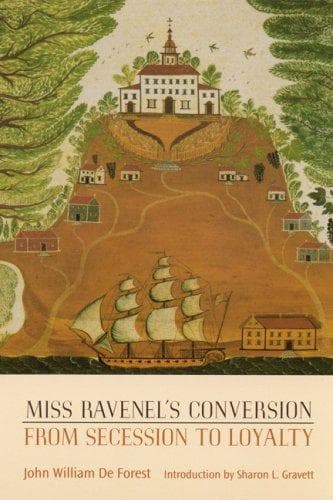
Miss Ravenel's conversion from secession to loyaltyDe Forest, John William
History
Miss Ravenel's conversion from secession to loyalty
De Forest, John William
Historical fiction; United States -- History -- Civil War, 1861-1865 -- Fiction; War stories; Women -- United States -- Fiction
We may take it for granted that Captain Colburne devoted much of his
time during this voyage to meditations on Miss Ravenel. But lovers'
reveries not being popular reading in these days, I shall omit all the
interesting matter thus offered, notwithstanding that the young man has
my earnest sympathies and good wishes.
One summer-like March morning the steam transport, black with men, lay
bowing to the snow-like sand-drifts of Ship Island; and by sunset the
regiment was ashore, the camp marked out, tents pitched, rations
cooking, and line formed for dress-parade; an instance of military
promptness which elicited the praises of Generals Phelps and Butler.
It is well known that the expedition against New Orleans started from
Ship Island as its base. Over the organization of the enterprise, the
battalion and brigade drills on the dazzling sands, the gun-boat fights
in the offing with rebel cruisers from Mobile, the arrival of Farragut's
frigates and Porter's bomb-schooners, and the grand review of the
expeditionary force, I must hurry without a word of description,
although I might make up a volume on these subjects from the newspapers
of the day, and from three or four long and enthusiastic letters which
Colburne wrote to Ravenel. But these matters do not properly come within
the scope of this narrative, which is biographical and not historical.
Parenthetically it may be well to remark that neither Carter nor
Colburne ever referred to Miss Ravenel in their few and brief
interviews. The latter was not disposed to talk of her to that listener;
and the former was too much occupied with his duties to give much
thought to an absent Dulcinea. The Colonel was no longer in that
youthfully tender stage when absence increases affection. To make him
love it was necessary to have a woman in pretty close personal
propinquity.
In a month or two from the arrival of the Tenth Barataria at Ship Island
it was again on board a transport, this time bound for New Orleans _via_
Fort Jackson.
"This part of Louisiana looks as the world must have looked in the
marsupial period," says Colburne in a letter to the Doctor written from
the Head of the Passes. "There are two narrow but seemingly endless
antennæ of land; between them rolls a river and outside of them spreads
an ocean. Dry land there is none, for the Mississippi being unusually
high the soil is submerged, and the trees and shrubs of these long
ribbons of underwood which enclose us have their boles in the water. I
do not understand why the ichthyosauri should have died out in
Louisiana. It certainly is not fitted, so far as I can see, for human
habitation. May it not have been the chaos (_vide_ Milton) through which
Satan floundered? Miss Ravenel will, I trust, forgive me for this
hypothesis when she learns that it is suggested by your theory that
Lucifer was and is and ever will be peculiarly at home in this part of
the world."
Public-domain text, read in full here on John Shaqi.
Reviews
Reviews
No reviews yet
Be the first to share your thoughts on this work.
Elsewhere in the archive
Join the Discussion
Join the discussion
Sign in to leave a comment or review.
Sign InorCreate an account