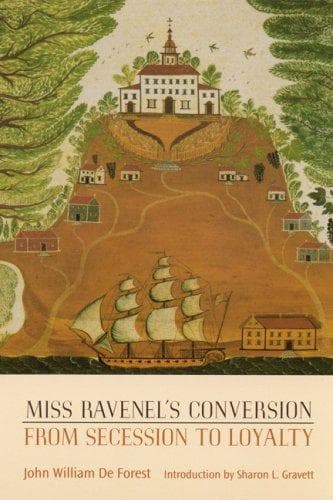
Miss Ravenel's conversion from secession to loyaltyDe Forest, John William
History
Miss Ravenel's conversion from secession to loyalty
De Forest, John William
Historical fiction; United States -- History -- Civil War, 1861-1865 -- Fiction; War stories; Women -- United States -- Fiction
"Well, if you insist, I am delighted of course.--But what a city! I must
break out with my amazement. Who could have believed that prosperous,
gay, bragging New Orleans would come to such grief and poverty! I seem
to have walked through Tyre and witnessed the fulfillment of the
predictions of the prophets. I have been haunted all day by Ezekiel.
Business gone, money gone, population gone. It is the hand of the
Almighty, bringing to shame the counsels of wicked rulers and the
predictions of lying seers. I ask no better proof than I have seen
to-day that there is a Divine Ruler. I hope that the whole land will not
have to pay as heavy a price as New Orleans to be quit of its compact
with the devil. We are all guilty to some extent. The North thought that
it could make money out of slavery and yet evade the natural
punishments of its naughty connivance. It thought that it could use the
South as a catspaw to pull its chestnuts out of the fires of hell. It
hoped to cheat the devil by doing its dirty business over the planter's
shoulders. But he is a sharp dealer. He will have his bond or his pound
of flesh. None of us ought to get off easily, and therefore I conclude
that we shall not."
Now who would suppose that the Doctor had in his mind all the while a
moral lecture to Colburne? Yet so it was: for this purpose had he gone
back to Tyre and Babylon; with this object in view had he descanted on
divine providence and the father of evil. It was his manner to reprove
and warn persons whom he liked, but not bluntly nor directly. He touched
them up gently, around the legs of other people, and over the shoulders
of events which lost their personal interest to most human beings
thousands of years ago. Please to notice how gradually, delicately, yet
surely he descended upon Colburne through epochal spaces of time, and
questions which involved the guilt and punishment of continents.
Public-domain text, read in full here on John Shaqi.
Reviews
Reviews
No reviews yet
Be the first to share your thoughts on this work.
Elsewhere in the archive
Join the Discussion
Join the discussion
Sign in to leave a comment or review.
Sign InorCreate an account