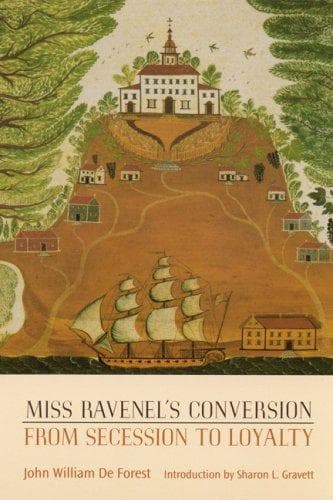
Miss Ravenel's conversion from secession to loyaltyDe Forest, John William
History
Miss Ravenel's conversion from secession to loyalty
De Forest, John William
Historical fiction; United States -- History -- Civil War, 1861-1865 -- Fiction; War stories; Women -- United States -- Fiction
"Just look at this city," he continued, "merely in its character as a
temptation to this army. Here is a chance for plunder and low
dissipation such as most of your simply educated and innocent country
lads of New England never before imagined. I have no doubt that there is
spoil enough here to demoralize a corps of veterans. I don't believe
that any thing can be more ruinous to a military force than free licence
to enrich itself at the expense of a conquered enemy. There is nobody so
needed here at this moment as John the Baptist. You remember that when
the soldiers came unto him he exhorted them, among other things, to be
content with their wages. I suppose the counsel was an echo of the
military wisdom of his Roman rulers. The greatest blessing that could be
vouchsafed this army would be to have John the Baptist crying night and
day in this wilderness of temptation, Be content with your wages! I
have hardly been here forty-eight hours, and I have already heard
stories of cotton speculations and sugar speculations, as they are slyly
called, yes, and of speculations in plate, pictures, furniture, and even
private clothing. It is sure disgrace and probable ruin. Please to
understand that I am not pleading the cause of the traitors who have
left their goods exposed to these peculations, but the cause of the army
which is thus exposed to temptation. I want to see it subjected to the
rules of honor and common sense. I want it protected from its
opportunities."
The Doctor had not alluded to plundered wine-cellars, but Colburne's
mind reverted to the forty-six emptied bottles of yesterday. John the
Baptist had not made mention of this elegant little dwelling, but this
convicted legionary glanced uneasily over its furniture and gimcracks.
He had not hitherto thought that he was doing any thing irregular or
immoral. In his opinion he was punishing rebellion by using the property
of rebels for the good or the pleasure of loyal citizens. The subject
had been presented to him in a new and disagreeable light, but he was
too fair-minded and conscientious not to give it his instant and serious
consideration. As for the forty-six bottles of wine, he might have
stated, had he supposed it to be worth while, that he had drunk only a
couple of glasses, and that he had quitted the orgie in disgust during
its early stages.
"I dare say this is all wrong," he admitted. "Unquestionably, if any
thing is confiscated, it should be for the direct and sole benefit of
the government. There ought to be a system about it. If we occupy these
houses we ought to receipt for the furniture and be responsible for it.
I wonder that something of the sort is not done. But you must remember
charitably how green most of us are, from the highest to the lowest, in
regard to the laws of war, the rights of conquerors, the discipline of
armies, and every thing that pertains to a state of hostilities. It is
very much as if the Quakers had taken to fighting."
Public-domain text, read in full here on John Shaqi.
Reviews
Reviews
No reviews yet
Be the first to share your thoughts on this work.
Elsewhere in the archive
Join the Discussion
Join the discussion
Sign in to leave a comment or review.
Sign InorCreate an account