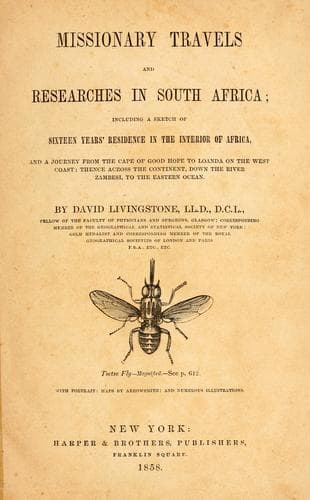
Missionary Travels and Researches in South AfricaLivingstone, David
Religion
Missionary Travels and Researches in South Africa
Livingstone, David
Missions -- South Africa; South Africa -- Description and travel
At Sebituane's death the chieftainship devolved, as her father intended,
on a daughter named Ma-mochisane. He had promised to show us his country
and to select a suitable locality for our residence. We had now to look
to the daughter, who was living twelve days to the north, at Naliele.
We were obliged, therefore, to remain until a message came from her;
and when it did, she gave us perfect liberty to visit any part of the
country we chose. Mr. Oswell and I then proceeded one hundred and thirty
miles to the northeast, to Sesheke; and in the end of June, 1851, we
were rewarded by the discovery of the Zambesi, in the centre of the
continent. This was a most important point, for that river was not
previously known to exist there at all. The Portuguese maps all
represent it as rising far to the east of where we now were; and if
ever any thing like a chain of trading stations had existed across
the country between the latitudes 12 Deg. and 18 Deg. south, this
magnificent portion of the river must have been known before. We saw it
at the end of the dry season, at the time when the river is about at its
lowest, and yet there was a breadth of from three hundred to six hundred
yards of deep flowing water. Mr. Oswell said he had never seen such a
fine river, even in India. At the period of its annual inundation it
rises fully twenty feet in perpendicular height, and floods fifteen or
twenty miles of lands adjacent to its banks.
The country over which we had traveled from the Chobe was perfectly
flat, except where there were large ant-hills, or the remains of former
ones, which had left mounds a few feet high. These are generally covered
with wild date-trees and palmyras, and in some parts there are forests
of mimosae and mopane. Occasionally the country between the Chobe and
Zambesi is flooded, and there are large patches of swamps lying near the
Chobe or on its banks. The Makololo were living among these swamps for
the sake of the protection the deep reedy rivers afforded them against
their enemies.
Now, in reference to a suitable locality for a settlement for myself,
I could not conscientiously ask them to abandon their defenses for my
convenience alone. The healthy districts were defenseless, and the safe
localities were so deleterious to human life, that the original Basutos
had nearly all been cut off by the fever; I therefore feared to subject
my family to the scourge.
Public-domain text, read in full here on John Shaqi.
Reviews
Reviews
No reviews yet
Be the first to share your thoughts on this work.
Elsewhere in the archive
Join the Discussion
Join the discussion
Sign in to leave a comment or review.
Sign InorCreate an account