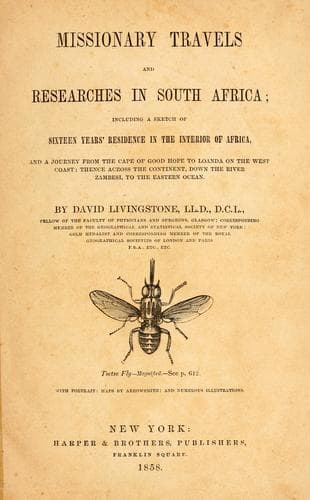
Missionary Travels and Researches in South AfricaLivingstone, David
Religion
Missionary Travels and Researches in South Africa
Livingstone, David
Missions -- South Africa; South Africa -- Description and travel
As we were the very first white men the inhabitants had ever seen, we
were visited by prodigious numbers. Among the first who came to see us
was a gentleman who appeared in a gaudy dressing-gown of printed calico.
Many of the Makololo, besides, had garments of blue, green, and red
baize, and also of printed cottons; on inquiry, we learned that these
had been purchased, in exchange for boys, from a tribe called Mambari,
which is situated near Bihe. This tribe began the slave-trade with
Sebituane only in 1850, and but for the unwillingness of Lechulatebe
to allow us to pass, we should have been with Sebituane in time to have
prevented it from commencing at all. The Mambari visited in ancient
times the chief of the Barotse, whom Sebituane conquered, and he refused
to allow any one to sell a child. They never came back again till 1850;
and as they had a number of old Portuguese guns marked "Legitimo
de Braga", which Sebituane thought would be excellent in any future
invasion of Matebele, he offered to purchase them with cattle or ivory,
but the Mambari refused every thing except boys about fourteen years of
age. The Makololo declare they never heard of people being bought and
sold till then, and disliked it, but the desire to possess the guns
prevailed, and eight old guns were exchanged for as many boys; these
were not their own children, but captives of the black races they had
conquered. I have never known in Africa an instance of a parent selling
his own offspring. The Makololo were afterward incited to make a foray
against some tribes to the eastward; the Mambari bargaining to use their
guns in the attack for the captives they might take, and the Makololo
were to have all the cattle. They went off with at least two hundred
slaves that year. During this foray the Makololo met some Arabs from
Zanzibar, who presented them with three English muskets, and in return
received about thirty of their captives.
In talking with my companions over these matters, the idea was suggested
that, if the slave-market were supplied with articles of European
manufacture by legitimate commerce, the trade in slaves would become
impossible. It seemed more feasible to give the goods, for which the
people now part with their servants, in exchange for ivory and other
products of the country, and thus prevent the trade at the beginning,
than to try to put a stop to it at any of the subsequent steps. This
could only be effected by establishing a highway from the coast into the
centre of the country.
Public-domain text, read in full here on John Shaqi.
Reviews
Reviews
No reviews yet
Be the first to share your thoughts on this work.
Elsewhere in the archive
Join the Discussion
Join the discussion
Sign in to leave a comment or review.
Sign InorCreate an account