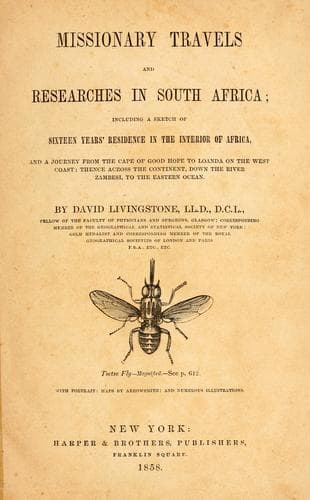
Missionary Travels and Researches in South AfricaLivingstone, David
Religion
Missionary Travels and Researches in South Africa
Livingstone, David
Missions -- South Africa; South Africa -- Description and travel
The peculiar formation of the country may explain why there is such
a difference in the vegetation between the 20th and 30th parallels of
latitude in South Africa and the same latitudes in Central Australia.
The want of vegetation is as true of some parts too in the centre of
South America as of Australia; and the cause of the difference holds out
a probability for the success of artesian wells in extensive tracts of
Africa now unpeopled solely on account of the want of surface water.
We may be allowed to speculate a little at least on the fact of much
greater vegetation, which, from whatever source it comes, presents for
South Africa prospects of future greatness which we can not hope for
in Central Australia. As the interior districts of the Cape Colony
are daily becoming of higher value, offering to honest industry a fair
remuneration for capital, and having a climate unequaled in salubrity
for consumptive patients, I should unhesitatingly recommend any farmer
at all afraid of that complaint in his family to try this colony. With
the means of education already possessed, and the onward and upward
movement of the Cape population, he need entertain no apprehensions of
his family sinking into barbarism.
The route we at this time followed ran along the middle, or skirted the
western zone before alluded to, until we reached the latitude of Lake
Ngami, where a totally different country begins. While in the colony,
we passed through districts inhabited by the descendants of Dutch and
French refugees who had fled from religious persecution. Those living
near the capital differ but little from the middle classes in
English counties, and are distinguished by public spirit and general
intelligence; while those situated far from the centres of civilization
are less informed, but are a body of frugal, industrious, and hospitable
peasantry. A most efficient system of public instruction was established
in the time of Governor Sir George Napier, on a plan drawn up in a great
measure by that accomplished philosopher, Sir John Herschel. The system
had to contend with less sectarian rancor than elsewhere; indeed, until
quite recently, that spirit, except in a mild form, was unknown.
The population here described ought not to be confounded with some
Boers who fled from British rule on account of the emancipation of their
Hottentot slaves, and perhaps never would have been so had not every now
and then some Rip Van Winkle started forth at the Cape to justify in the
public prints the deeds of blood and slave-hunting in the far interior.
It is therefore not to be wondered at if the whole race is confounded
and held in low estimation by those who do not know the real composition
of the Cape community.
Public-domain text, read in full here on John Shaqi.
Reviews
Reviews
No reviews yet
Be the first to share your thoughts on this work.
Elsewhere in the archive
Join the Discussion
Join the discussion
Sign in to leave a comment or review.
Sign InorCreate an account