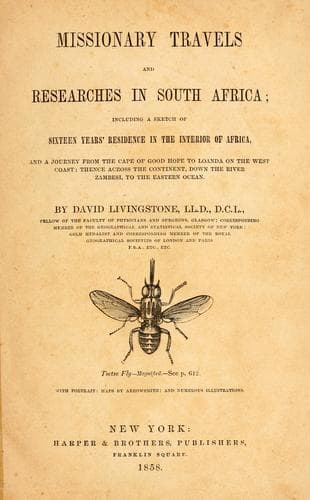
Missionary Travels and Researches in South AfricaLivingstone, David
Religion
Missionary Travels and Researches in South Africa
Livingstone, David
Missions -- South Africa; South Africa -- Description and travel
Population among the Boers increases rapidly; they marry soon, are
seldom sterile, and continue to have children late. I once met a worthy
matron whose husband thought it right to imitate the conduct of Abraham
while Sarah was barren; she evidently agreed in the propriety of the
measure, for she was pleased to hear the children by a mother of what
has been thought an inferior race address her as their mother. Orphans
are never allowed to remain long destitute; and instances are frequent
in which a tender-hearted farmer has adopted a fatherless child, and
when it came of age portioned it as his own.
Two centuries of the South African climate have not had much effect upon
the physical condition of the Boers. They are a shade darker, or
rather ruddier, than Europeans, and are never cadaverous-looking, as
descendants of Europeans are said to be elsewhere. There is a tendency
to the development of steatopyga, so characteristic of Arabs and other
African tribes; and it is probable that the interior Boers in another
century will become in color what the learned imagine our progenitors,
Adam and Eve, to have been.
The parts of the colony through which we passed were of sterile aspect;
and, as the present winter had been preceded by a severe drought,
many farmers had lost two thirds of their stock. The landscape was
uninviting; the hills, destitute of trees, were of a dark brown color,
and the scanty vegetation on the plains made me feel that they deserved
the name of Desert more than the Kalahari. When first taken possession
of, these parts are said to have been covered with a coating of grass,
but that has disappeared with the antelopes which fed upon it, and
a crop of mesembryanthemums and crassulas occupies its place. It is
curious to observe how, in nature, organizations the most dissimilar
are mutually dependent on each other for their perpetuation. Here the
original grasses were dependent for dissemination on the grass-feeding
animals, which scattered the seeds. When, by the death of the antelopes,
no fresh sowing was made, the African droughts proved too much for
this form of vegetation. But even this contingency was foreseen by
the Omniscient One; for, as we may now observe in the Kalahari Desert,
another family of plants, the mesembryanthemums, stood ready to
neutralize the aridity which must otherwise have followed. This family
of plants possesses seed-vessels which remain firmly shut on their
contents while the soil is hot and dry, and thus preserve the vegetative
power intact during the highest heat of the torrid sun; but when rain
falls, the seed-vessel opens and sheds its contents just when there is
the greatest probability of their vegetating. In other plants heat and
drought cause the seed-vessels to burst and shed their charge.
Public-domain text, read in full here on John Shaqi.
Reviews
Reviews
No reviews yet
Be the first to share your thoughts on this work.
Elsewhere in the archive
Join the Discussion
Join the discussion
Sign in to leave a comment or review.
Sign InorCreate an account