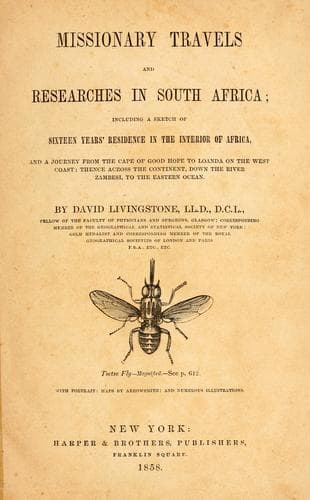
Missionary Travels and Researches in South AfricaLivingstone, David
Religion
Missionary Travels and Researches in South Africa
Livingstone, David
Missions -- South Africa; South Africa -- Description and travel
When we reached Motito, forty miles off, we met Sechele on his way, as
he said, "to the Queen of England." Two of his own children, and their
mother, a former wife, were among the captives seized by the Boers; and
being strongly imbued with the then very prevalent notion of England's
justice and generosity, he thought that in consequence of the violated
treaty he had a fair case to lay before her majesty. He employed all his
eloquence and powers of persuasion to induce me to accompany him, but I
excused myself on the ground that my arrangements were already made
for exploring the north. On explaining the difficulties of the way,
and endeavoring to dissuade him from the attempt, on account of the
knowledge I possessed of the governor's policy, he put the pointed
question, "Will the queen not listen to me, supposing I should reach
her?" I replied, "I believe she would listen, but the difficulty is
to get to her." "Well, I shall reach her," expressed his final
determination. Others explained the difficulties more fully, but nothing
could shake his resolution. When he reached Bloemfontein he found the
English army just returning from a battle with the Basutos, in which
both parties claimed the victory, and both were glad that a second
engagement was not tried. Our officers invited Sechele to dine with
them, heard his story, and collected a handsome sum of money to enable
him to pursue his journey to England. The commander refrained from
noticing him, as a single word in favor of the restoration of the
children of Sechele would have been a virtual confession of the failure
of his own policy at the very outset. Sechele proceeded as far as the
Cape; but his resources being there expended, he was obliged to return
to his own country, one thousand miles distant, without accomplishing
the object of his journey.
On his return he adopted a mode of punishment which he had seen in the
colony, namely, making criminals work on the public roads. And he has
since, I am informed, made himself the missionary to his own people.
He is tall, rather corpulent, and has more of the negro feature than
common, but has large eyes. He is very dark, and his people swear by
"Black Sechele". He has great intelligence, reads well, and is a fluent
speaker. Great numbers of the tribes formerly living under the Boers
have taken refuge under his sway, and he is now greater in power than he
was before the attack on Kolobeng.
Public-domain text, read in full here on John Shaqi.
Reviews
Reviews
No reviews yet
Be the first to share your thoughts on this work.
Elsewhere in the archive
Join the Discussion
Join the discussion
Sign in to leave a comment or review.
Sign InorCreate an account