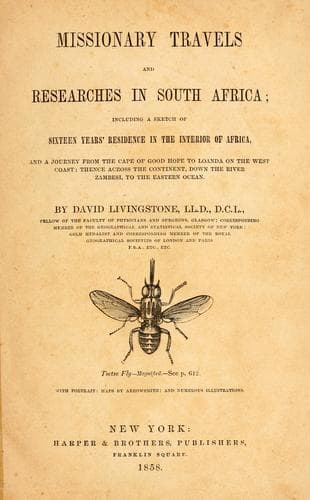
Missionary Travels and Researches in South AfricaLivingstone, David
Religion
Missionary Travels and Researches in South Africa
Livingstone, David
Missions -- South Africa; South Africa -- Description and travel
Having parted with Sechele, we skirted along the Kalahari Desert, and
sometimes within its borders, giving the Boers a wide berth. A
larger fall of rain than usual had occurred in 1852, and that was the
completion of a cycle of eleven or twelve years, at which the same
phenomenon is reported to have happened on three occasions. An unusually
large crop of melons had appeared in consequence. We had the pleasure
of meeting with Mr. J. Macabe returning from Lake Ngami, which he had
succeeded in reaching by going right across the Desert from a point
a little to the south of Kolobeng. The accounts of the abundance of
watermelons were amply confirmed by this energetic traveler; for, having
these in vast quantities, his cattle subsisted on the fluid contained in
them for a period of no less than twenty-one days; and when at last
they reached a supply of water, they did not seem to care much about it.
Coming to the lake from the southeast, he crossed the Teoughe, and went
round the northern part of it, and is the only European traveler who had
actually seen it all. His estimate of the extent of the lake is higher
than that given by Mr. Oswell and myself, or from about ninety to one
hundred miles in circumference. Before the lake was discovered, Macabe
wrote a letter in one of the Cape papers recommending a certain route
as likely to lead to it. The Transvaal Boers fined him 500 dollars for
writing about "ouze felt", OUR country, and imprisoned him, too, till
the fine was paid. I now learned from his own lips that the public
report of this is true. Mr. Macabe's companion, Mahar, was mistaken by a
tribe of Barolongs for a Boer, and shot as he approached their village.
When Macabe came up and explained that he was an Englishman, they
expressed the utmost regret, and helped to bury him. This was the first
case in recent times of an Englishman being slain by the Bechuanas.
We afterward heard that there had been some fighting between these
Barolongs and the Boers, and that there had been capturing of cattle on
both sides. If this was true, I can only say that it was the first time
that I ever heard of cattle being taken by Bechuanas. This was a Caffre
war in stage the second; the third stage in the development is when both
sides are equally well armed and afraid of each other; the fourth, when
the English take up a quarrel not their own, and the Boers slip out of
the fray.
Public-domain text, read in full here on John Shaqi.
Reviews
Reviews
No reviews yet
Be the first to share your thoughts on this work.
Elsewhere in the archive
Join the Discussion
Join the discussion
Sign in to leave a comment or review.
Sign InorCreate an account