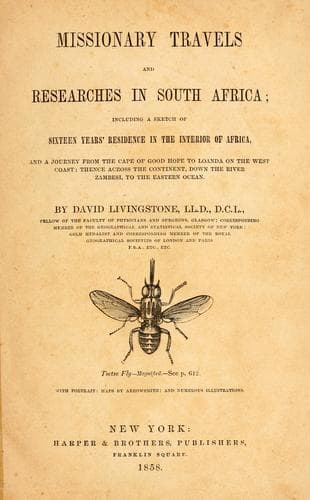
Missionary Travels and Researches in South AfricaLivingstone, David
Religion
Missionary Travels and Researches in South Africa
Livingstone, David
Missions -- South Africa; South Africa -- Description and travel
"The insect (and its secretion) on the leaves of the bauhinia,
and which is eaten by the Africans, proves to be a species of
Psylla, a genus of small, very active Homoptera, of which we
have one very common species in the box; but our species,
Psylla buxi, emits its secretion in the shape of very long,
white, cotton-like filaments. But there is a species in New
Holland, found on the leaves of the Eucalyptus, which emits a
secretion very similar to that of Dr. Livingstone's species.
This Australian secretion (and its insect originator) is known
by the name of wo-me-la, and, like Dr. Livingstone's, it is
scraped off the leaves and eaten by the aborigines as a
saccharine dainty. The insects found beneath the secretion,
brought home by Dr. Livingstone, are in the pupa state, being
flattened, with large scales at the sides of the body,
inclosing the future wings of the insect. The body is pale
yellowish-colored, with dark-brown spots. It will be
impossible to describe the species technically until we
receive the perfect insect. The secretion itself is flat and
circular, apparently deposited in concentric rings, gradually
increasing in size till the patches are about a quarter or a
third of an inch in diameter.
Jno. O. Westwood."
In passing along we see every where the power of vegetation in breaking
up the outer crust of tufa. A mopane-tree, growing in a small chink, as
it increases in size rends and lifts up large fragments of the rock
all around it, subjecting them to the disintegrating influence of the
atmosphere. The wood is hard, and of a fine red color, and is named
iron-wood by the Portuguese. The inhabitants, observing that the
mopane is more frequently struck by lightning than other trees,
caution travelers never to seek its shade when a thunder-storm is
near--"Lightning hates it;" while another tree, the "Morala", which has
three spines opposite each other on the branches, and has never been
known to be touched by lightning, is esteemed, even as far as Angola, a
protection against the electric fluid. Branches of it may be seen placed
on the houses of the Portuguese for the same purpose. The natives,
moreover, believe that a man is thoroughly protected from an enraged
elephant if he can get into the shade of this tree. There may not be
much in this, but there is frequently some foundation of truth in their
observations.
Public-domain text, read in full here on John Shaqi.
Reviews
Reviews
No reviews yet
Be the first to share your thoughts on this work.
Elsewhere in the archive
Join the Discussion
Join the discussion
Sign in to leave a comment or review.
Sign InorCreate an account