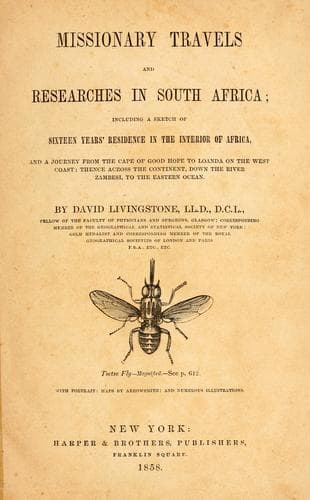
Missionary Travels and Researches in South AfricaLivingstone, David
Religion
Missionary Travels and Researches in South Africa
Livingstone, David
Missions -- South Africa; South Africa -- Description and travel
At Rapesh we came among our old friends the Bushmen, under Horoye. This
man, Horoye, a good specimen of that tribe, and his son Mokantsa and
others, were at least six feet high, and of a darker color than the
Bushmen of the south. They have always plenty of food and water; and as
they frequent the Zouga as often as the game in company with which they
live, their life is very different from that of the inhabitants of the
thirsty plains of the Kalahari. The animal they refrain from eating is
the goat, which fact, taken in connection with the superstitious dread
which exists in every tribe toward a particular animal, is significant
of their feelings to the only animals they could have domesticated in
their desert home. They are a merry laughing set, and do not tell lies
wantonly. They have in their superstitious rites more appearance of
worship than the Bechuanas; and at a Bushman's grave we once came to on
the Zouga, the observances showed distinctly that they regarded the
dead as still in another state of being; for they addressed him, and
requested him not to be offended even though they wished still to remain
a little while longer in this world.
Those among whom we now were kill many elephants, and when the moon is
full choose that time for the chase, on account of its coolness. Hunting
this animal is the best test of courage this country affords. The
Bushmen choose the moment succeeding a charge, when the elephant is out
of breath, to run in and give him a stab with their long-bladed spears.
In this case the uncivilized have the advantage over us, but I believe
that with half their training Englishmen would beat the Bushmen. Our
present form of civilization does not necessarily produce effeminacy,
though it unquestionably increases the beauty, courage, and physical
powers of the race. When at Kolobeng I took notes of the different
numbers of elephants killed in the course of the season by the various
parties which went past our dwelling, in order to form an idea of the
probable annual destruction of this noble animal. There were parties of
Griquas, Bechuanas, Boers, and Englishmen. All were eager to distinguish
themselves, and success depended mainly on the courage which leads the
huntsman to go close to the animal, and not waste the force of his shot
on the air. It was noticeable that the average for the natives was under
one per man, for the Griquas one per man, for the Boers two, and for
the English officers twenty each. This was the more remarkable, as the
Griquas, Boers, and Bechuanas employed both dogs and natives to assist
them, while the English hunters generally had no assistance from either.
They approached to within thirty yards of the animal, while the others
stood at a distance of a hundred yards, or even more, and of course
spent all the force of their bullets on the air. One elephant was found
by Mr. Oswell with quite a crowd of bullets in his side, all evidently
Public-domain text, read in full here on John Shaqi.
Reviews
Reviews
No reviews yet
Be the first to share your thoughts on this work.
Elsewhere in the archive
Join the Discussion
Join the discussion
Sign in to leave a comment or review.
Sign InorCreate an account