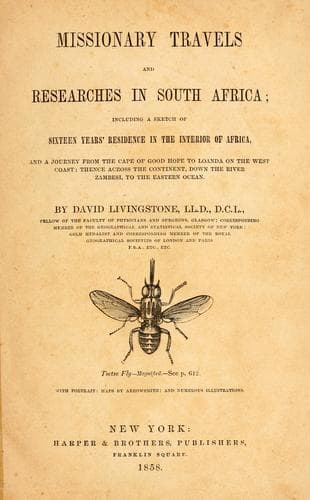
Missionary Travels and Researches in South AfricaLivingstone, David
Religion
Missionary Travels and Researches in South Africa
Livingstone, David
Missions -- South Africa; South Africa -- Description and travel
I sent a message at the same time to Lechulatebe advising him to give
up the course he had adopted, and especially the song; because, though
Sebituane was dead, the arms with which he had fought were still alive
and strong.
Sekeletu, in order to follow up his father's instructions and promote
peace, sent ten cows to Lechulatebe to be exchanged for sheep; these
animals thrive well in a bushy country like that around the lake, but
will scarcely live in the flat prairies between the net-work of waters
north of the Chobe. The men who took the cows carried a number of hoes
to purchase goats besides. Lechulatebe took the cows and sent back an
equal number of sheep. Now, according to the relative value of sheep and
cows in these parts, he ought to have sent sixty or seventy.
One of the men who had hoes was trying to purchase in a village without
formal leave from Lechulatebe; this chief punished him by making him sit
some hours on the broiling hot sand (at least 130 Deg.). This farther
offense put a stop to amicable relations between the two tribes
altogether. It was a case in which a very small tribe, commanded by
a weak and foolish chief, had got possession of fire-arms, and felt
conscious of ability to cope with a numerous and warlike race. Such
cases are the only ones in which the possession of fire-arms does evil.
The universal effect of the diffusion of the more potent instruments of
warfare in Africa is the same as among ourselves. Fire-arms render wars
less frequent and less bloody. It is indeed exceedingly rare to hear of
two tribes having guns going to war with each other; and, as nearly all
the feuds, in the south at least, have been about cattle, the risk which
must be incurred from long shots generally proves a preventive to the
foray.
The Makololo were prevailed upon to keep the peace during my residence
with them, but it was easy to perceive that public opinion was against
sparing a tribe of Bechuanas for whom the Makololo entertained the most
sovereign contempt. The young men would remark, "Lechulatebe is herding
our cows for us; let us only go, we shall 'lift' the price of them in
sheep," etc.
As the Makololo are the most northerly of the Bechuanas, we may glance
back at this family of Africans before entering on the branch of the
negro family which the Makololo distinguish by the term Makalaka. The
name Bechuana seems derived from the word Chuana--alike, or equal--with
the personal pronoun Ba (they) prefixed, and therefore means fellows
or equals. Some have supposed the name to have arisen from a mistake of
some traveler, who, on asking individuals of this nation concerning the
tribes living beyond them, received the answer, Bachuana, "they (are)
alike"; meaning, "They are the same as we are"; and that this nameless
traveler, who never wrote a word about them, managed to ingraft his
mistake as a generic term on a nation extending from the Orange River to
18 Deg. south latitude.*
Public-domain text, read in full here on John Shaqi.
Reviews
Reviews
No reviews yet
Be the first to share your thoughts on this work.
Elsewhere in the archive
Join the Discussion
Join the discussion
Sign in to leave a comment or review.
Sign InorCreate an account