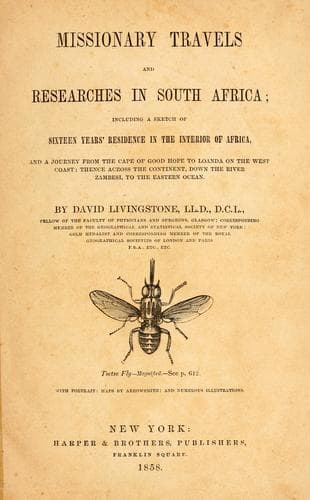
Missionary Travels and Researches in South AfricaLivingstone, David
Religion
Missionary Travels and Researches in South Africa
Livingstone, David
Missions -- South Africa; South Africa -- Description and travel
* The Makololo have conquered the country as far as 14 Deg.
south, but it is still peopled chiefly by the black tribes
named Makalaka.
As the name was found in use among those who had no intercourse with
Europeans, before we can receive the above explanation we must believe
that the unknown traveler knew the language sufficiently well to ask a
question, but not to understand the answer. We may add, that the way in
which they still continue to use the word seems to require no fanciful
interpretation. When addressed with any degree of scorn, they reply, "We
are Bachuana, or equals--we are not inferior to any of our nation,"
in exactly the same sense as Irishmen or Scotchmen, in the same
circumstances, would reply, "We are Britons," or "We are Englishmen."
Most other tribes are known by the terms applied to them by strangers
only, as the Caffres, Hottentots, and Bushmen. The Bechuanas alone use
the term to themselves as a generic one for the whole nation. They have
managed, also, to give a comprehensive name to the whites, viz., Makoa,
though they can not explain the derivation of it any more than of their
own. It seems to mean "handsome", from the manner in which they use
it to indicate beauty; but there is a word so very like it meaning
"infirm", or "weak", that Burchell's conjecture is probably the right
one. "The different Hottentot tribes were known by names terminating in
'kua', which means 'man', and the Bechuanas simply added the prefix
Ma, denoting a nation." They themselves were first known as Briquas, or
"goat-men". The language of the Bechuanas is termed Sichuana; that of
the whites (or Makoa) is called Sekoa.
The Makololo, or Basuto, have carried their powers of generalization
still farther, and arranged the other parts of the same great family
of South Africans into three divisions: 1st. The Matebele, or
Makonkobi--the Caffre family living on the eastern side of the country;
2d. The Bakoni, or Basuto; and, 3d. The Bakalahari, or Bechuanas, living
in the central parts, which includes all those tribes living in or
adjacent to the great Kalahari Desert.
1st. The Caffres are divided by themselves into various subdivisions, as
Amakosa, Amapanda, and other well-known titles. They consider the name
Caffre as an insulting epithet.
The Zulus of Natal belong to the same family, and they are as famed
for their honesty as their brethren who live adjacent to our colonial
frontier are renowned for cattle-lifting. The Recorder of Natal declared
of them that history does not present another instance in which so
much security for life and property has been enjoyed, as has been
experienced, during the whole period of English occupation, by ten
thousand colonists, in the midst of one hundred thousand Zulus.
Public-domain text, read in full here on John Shaqi.
Reviews
Reviews
No reviews yet
Be the first to share your thoughts on this work.
Elsewhere in the archive
Join the Discussion
Join the discussion
Sign in to leave a comment or review.
Sign InorCreate an account