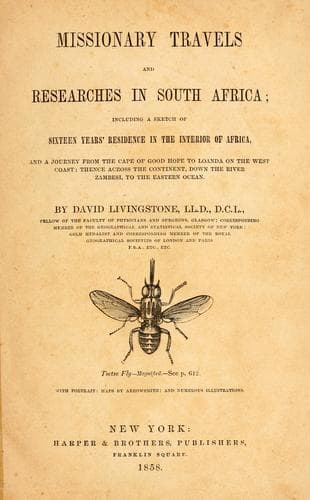
Missionary Travels and Researches in South AfricaLivingstone, David
Religion
Missionary Travels and Researches in South Africa
Livingstone, David
Missions -- South Africa; South Africa -- Description and travel
But Santuru was once visited by the Mambari, and a distinct recollection
of that visit is retained. They came to purchase slaves, and both
Santuru and his head men refused them permission to buy any of the
people. The Makololo quoted this precedent when speaking of the Mambari,
and said that they, as the present masters of the country, had as good
a right to expel them as Santuru. The Mambari reside near Bihe, under
an Ambonda chief named Kangombe. They profess to use the slaves for
domestic purposes alone.
Some of these Mambari visited us while at Naliele. They are of the
Ambonda family, which inhabits the country southeast of Angola, and
speak the Bunda dialect, which is of the same family of languages with
the Barotse, Bayeiye, etc., or those black tribes comprehended under the
general term Makalaka. They plait their hair in three-fold cords, and
lay them carefully down around the sides of the head. They are quite as
dark as the Barotse, but have among them a number of half-castes, with
their peculiar yellow sickly hue. On inquiring why they had fled on my
approach to Linyanti, they let me know that they had a vivid idea of the
customs of English cruisers on the coast. They showed also their habits
in their own country by digging up and eating, even here where
large game abounds, the mice and moles which infest the country. The
half-castes, or native Portuguese, could all read and write, and the
head of the party, if not a real Portuguese, had European hair, and,
influenced probably by the letter of recommendation which I held from
the Chevalier Duprat, his most faithful majesty's Arbitrator in the
British and Portuguese Mixed Commission at Cape Town, was evidently
anxious to show me all the kindness in his power. These persons I feel
assured were the first individuals of Portuguese blood who ever saw the
Zambesi in the centre of the country, and they had reached it two years
after our discovery in 1851.
Public-domain text, read in full here on John Shaqi.
Reviews
Reviews
No reviews yet
Be the first to share your thoughts on this work.
Elsewhere in the archive
Join the Discussion
Join the discussion
Sign in to leave a comment or review.
Sign InorCreate an account