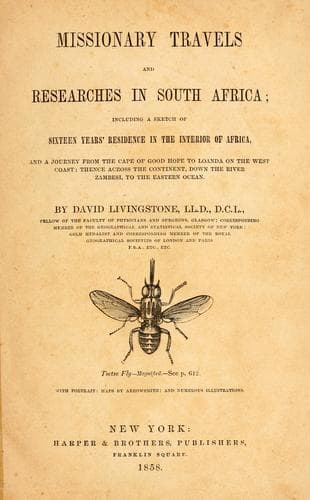
Missionary Travels and Researches in South AfricaLivingstone, David
Religion
Missionary Travels and Researches in South Africa
Livingstone, David
Missions -- South Africa; South Africa -- Description and travel
The town or mound of Santuru's mother was shown to me; this was the
first symptom of an altered state of feeling with regard to the female
sex that I had observed. There are few or no cases of women being
elevated to the headships of towns further south. The Barotse also
showed some relics of their chief, which evinced a greater amount of the
religious feeling than I had ever known displayed among Bechuanas. His
more recent capital, Lilonda, built, too, on an artificial mound,
is covered with different kinds of trees, transplanted when young by
himself. They form a grove on the end of the mound, in which are to be
seen various instruments of iron just in the state he left them. One
looks like the guard of a basket-hilted sword; another has an upright
stem of the metal, on which are placed branches worked at the ends into
miniature axes, hoes, and spears; on these he was accustomed to present
offerings, according as he desired favors to be conferred in undertaking
hewing, agriculture, or fighting. The people still living there, in
charge of these articles, were supported by presents from the chief; and
the Makololo sometimes follow the example. This was the nearest approach
to a priesthood I met. When I asked them to part with one of these
relics, they replied, "Oh no, he refuses." "Who refuses?" "Santuru," was
their reply, showing their belief in a future state of existence. After
explaining to them, as I always did when opportunity offered, the nature
of true worship, and praying with them in the simple form which needs no
offering from the worshiper except that of the heart, and planting some
fruit-tree seeds in the grove, we departed.
Another incident, which occurred at the confluence of the Leeba and
Leeambye, may be mentioned here, as showing a more vivid perception of
the existence of spiritual beings, and greater proneness to worship than
among the Bechuanas. Having taken lunar observations in the morning,
I was waiting for a meridian altitude of the sun for the latitude; my
chief boatman was sitting by, in order to pack up the instruments
as soon as I had finished; there was a large halo, about 20 Deg. in
diameter, round the sun; thinking that the humidity of the atmosphere,
which this indicated, might betoken rain, I asked him if his experience
did not lead him to the same view. "Oh no," replied he; "it is the
Barimo (gods or departed spirits), who have called a picho; don't you
see they have the Lord (sun) in the centre?"
Public-domain text, read in full here on John Shaqi.
Reviews
Reviews
No reviews yet
Be the first to share your thoughts on this work.
Elsewhere in the archive
Join the Discussion
Join the discussion
Sign in to leave a comment or review.
Sign InorCreate an account