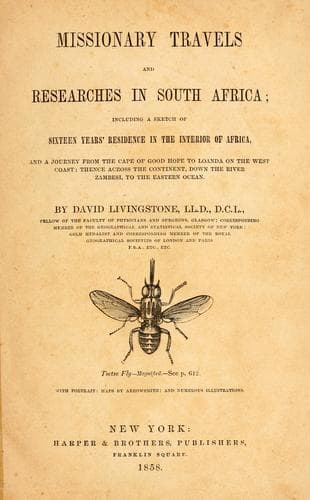
Missionary Travels and Researches in South AfricaLivingstone, David
Religion
Missionary Travels and Researches in South Africa
Livingstone, David
Missions -- South Africa; South Africa -- Description and travel
I gave many public addresses to the people of Sesheke under the
outspreading camel-thorn-tree, which serves as a shade to the kotla on
the high bank of the river. It was pleasant to see the long lines of
men, women, and children winding along from different quarters of the
town, each party following behind their respective head men. They often
amounted to between five and six hundred souls, and required an exertion
of voice which brought back the complaint for which I had got the uvula
excised at the Cape. They were always very attentive; and Moriantsane,
in order, as he thought, to please me, on one occasion rose up in the
middle of the discourse, and hurled his staff at the heads of some young
fellows whom he saw working with a skin instead of listening. My hearers
sometimes put very sensible questions on the subjects brought before
them; at other times they introduced the most frivolous nonsense
immediately after hearing the most solemn truths. Some begin to pray to
Jesus in secret as soon as they hear of the white man's God, with but
little idea of what they are about; and no doubt are heard by Him who,
like a father, pitieth his children. Others, waking by night, recollect
what has been said about the future world so clearly that they tell
next day what a fright they got by it, and resolve not to listen to the
teaching again; and not a few keep to the determination not to believe,
as certain villagers in the south, who put all their cocks to death
because they crowed the words, "Tlang lo rapeleng"--"Come along to
prayers".
On recovering partially from a severe attack of fever which remained
upon me ever since our passing the village of Moremi on the Chobe, we
made ready for our departure up the river by sending messages before
us to the villages to prepare food. We took four elephants' tusks,
belonging to Sekeletu, with us, as a means of testing the difference of
prices between the Portuguese, whom we expected to reach, and the white
traders from the south. Moriantsane supplied us well with honey, milk,
and meal. The rains were just commencing in this district; but, though
showers sufficient to lay the dust had fallen, they had no influence
whatever on the amount of water in the river, yet never was there less
in any part than three hundred yards of a deep flowing stream.
Our progress up the river was rather slow; this was caused by waiting
opposite different villages for supplies of food. We might have done
with much less than we got; but my Makololo man, Pitsane, knew of the
generous orders of Sekeletu, and was not at all disposed to allow them
to remain a dead letter. The villages of the Banyeti contributed large
quantities of mosibe, a bright red bean yielded by a large tree. The
pulp inclosing the seed is not much thicker than a red wafer, and is
the portion used. It requires the addition of honey to render it at all
palatable.
Public-domain text, read in full here on John Shaqi.
Reviews
Reviews
No reviews yet
Be the first to share your thoughts on this work.
Elsewhere in the archive
Join the Discussion
Join the discussion
Sign in to leave a comment or review.
Sign InorCreate an account