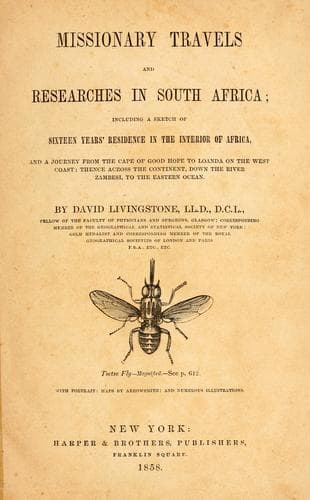
Missionary Travels and Researches in South AfricaLivingstone, David
Religion
Missionary Travels and Researches in South Africa
Livingstone, David
Missions -- South Africa; South Africa -- Description and travel
To these were added great numbers of the fruit which yields a variety of
the nux vomica, from which we derive that virulent poison strychnia. The
pulp between the nuts is the part eaten, and it is of a pleasant juicy
nature, having a sweet acidulous taste. The fruit itself resembles a
large yellow orange, but the rind is hard, and, with the pips and bark,
contains much of the deadly poison. They evince their noxious qualities
by an intensely bitter taste. The nuts, swallowed inadvertently, cause
considerable pain, but not death; and to avoid this inconvenience, the
people dry the pulp before the fire, in order to be able the more easily
to get rid of the noxious seeds.
A much better fruit, called mobola, was also presented to us. This
bears, around a pretty large stone, as much of the fleshy part as the
common date, and it is stripped off the seeds and preserved in bags in
a similar manner to that fruit. Besides sweetness, the mobola has the
flavor of strawberries, with a touch of nauseousness. We carried some of
them, dried as provisions, more than a hundred miles from this spot.
The next fruit, named mamosho (mother of morning), is the most delicious
of all. It is about the size of a walnut, and, unlike most of the other
uncultivated fruits, has a seed no larger than that of a date. The
fleshy part is juicy, and somewhat like the cashew-apple, with a
pleasant acidity added. Fruits similar to those which are here found
on trees are found on the plains of the Kalahari, growing on mere
herbaceous plants. There are several other examples of a similar nature.
Shrubs, well known as such in the south, assume the rank of trees as
we go to the north; and the change is quite gradual as our latitude
decreases, the gradations being herbaceous plants, shrubs, bushes,
small, then large trees. But it is questionable if, in the cases of
mamosho, mobola, and mawa, the tree and shrub are identical, though the
fruits so closely resemble each other; for I found both the dwarf and
tree in the same latitude. There is also a difference in the leaves, and
they bear at different seasons.
Public-domain text, read in full here on John Shaqi.
Reviews
Reviews
No reviews yet
Be the first to share your thoughts on this work.
Elsewhere in the archive
Join the Discussion
Join the discussion
Sign in to leave a comment or review.
Sign InorCreate an account