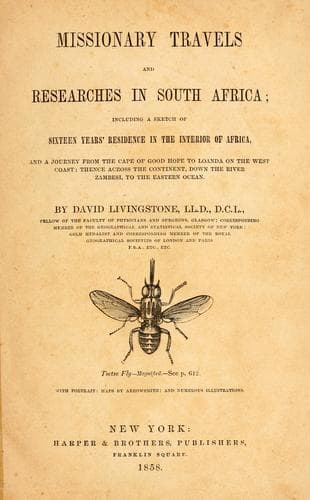
Missionary Travels and Researches in South AfricaLivingstone, David
Religion
Missionary Travels and Researches in South Africa
Livingstone, David
Missions -- South Africa; South Africa -- Description and travel
In passing along under the overhanging trees of the banks, we often
saw the pretty turtle-doves sitting peacefully on their nests above the
roaring torrent. An ibis* had perched her home on the end of a stump.
Her loud, harsh scream of "Wa-wa-wa", and the piping of the fish-hawk,
are sounds which can never be forgotten by any one who has sailed on
the rivers north of 20 Deg. south. If we step on shore, the 'Charadrius
caruncula', a species of plover, a most plaguy sort of "public-spirited
individual", follows you, flying overhead, and is most persevering in
its attempts to give fair warning to all the animals within hearing to
flee from the approaching danger. The alarm-note, "tinc-tinc-tinc", of
another variety of the same family ('Pluvianus armatus' of Burchell) has
so much of a metallic ring, that this bird is called "setula-tsipi", or
hammering-iron. It is furnished with a sharp spur on its shoulder, much
like that on the heel of a cock, but scarcely half an inch in length.
Conscious of power, it may be seen chasing the white-necked raven with
great fury, and making even that comparatively large bird call out
from fear. It is this bird which is famed for its friendship with the
crocodile of the Nile by the name 'siksak', and which Mr. St. John
actually saw performing the part of toothpicker to the ugly reptile.
They are frequently seen on the sand-banks with the alligator, and, to
one passing by, often appear as if on that reptile's back; but I never
had the good fortune to witness the operation described not only by
St. John and Geoffrey St. Hilaire, but also by Herodotus. However, that
which none of these authors knew my head boatman, Mashauana, stopped the
canoe to tell us, namely, that a water-turtle which, in trying to ascend
a steep bank to lay her eggs, had toppled on her back, thus enabling us
to capture her, was an infallible omen of good luck for our journey.
* The 'Hagidash', Latham; or 'Tantalus capensis' of Lich.
Among the forest-trees which line the banks of the rocky parts of the
Leeambye several new birds were observed. Some are musical, and the
songs are pleasant in contrast with the harsh voice of the little green,
yellow-shouldered parrots of the country. There are also great numbers
of jet-black weavers, with yellowish-brown band on the shoulders.
Here we saw, for the first time, a pretty little bird, colored dark
blue, except the wings and tail, which were of a chocolate hue. From the
tail two feathers are prolonged beyond the rest six inches. Also,
little birds colored white and black, of great vivacity, and always in
companies of six or eight together, and various others. From want of
books of reference, I could not decide whether they were actually new to
science.
Public-domain text, read in full here on John Shaqi.
Reviews
Reviews
No reviews yet
Be the first to share your thoughts on this work.
Elsewhere in the archive
Join the Discussion
Join the discussion
Sign in to leave a comment or review.
Sign InorCreate an account