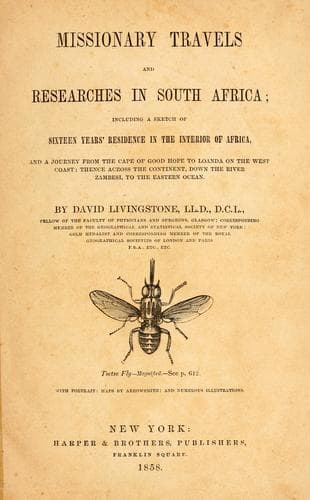
Missionary Travels and Researches in South AfricaLivingstone, David
Religion
Missionary Travels and Researches in South Africa
Livingstone, David
Missions -- South Africa; South Africa -- Description and travel
Francolins and Guinea-fowl abound along the banks; and on every dead
tree and piece of rock may be seen one or two species of the web-footed
'Plotus', darter, or snake-bird. They sit most of the day sunning
themselves over the stream, sometimes standing erect with their wings
outstretched; occasionally they may be seen engaged in fishing by
diving, and, as they swim about, their bodies are so much submerged that
hardly any thing appears above the water but their necks. The chief time
of feeding is by night, and, as the sun declines, they may be seen in
flocks flying from their roosting-places to the fishing-grounds. This is
a most difficult bird to catch when disabled. It is thoroughly expert
in diving--goes down so adroitly and comes up again in the most unlikely
places, that the people, though most skillful in the management of the
canoes, can rarely secure them. The rump of the darter is remarkably
prolonged, and capable of being bent, so as to act both as a rudder in
swimming, and as a lever to lift the bird high enough out of the water
to give free scope to its wings. It can rise at will from the water by
means of this appendage.
The fine fish-hawk, with white head and neck, and reddish-chocolate
colored body, may also frequently be seen perched on the trees, and fish
are often found dead which have fallen victims to its talons. One most
frequently seen in this condition is itself a destroyer of fish. It is
a stout-bodied fish, about fifteen or eighteen inches long, of a light
yellow color, and gayly ornamented with stripes and spots. It has a
most imposing array of sharp, conical teeth outside the lips--objects
of dread to the fisherman, for it can use them effectually. One which
we picked up dead had killed itself by swallowing another fish, which,
though too large for its stomach and throat, could not be disgorged.
This fish-hawk generally kills more prey than it can devour. It eats a
portion of the back of the fish, and leaves the rest for the Barotse,
who often had a race across the river when they saw an abandoned morsel
lying on the opposite sand-banks. The hawk is, however, not always so
generous, for, as I myself was a witness on the Zouga, it sometimes
plunders the purse of the pelican. Soaring over head, and seeing this
large, stupid bird fishing beneath, it watches till a fine fish is safe
in the pelican's pouch; then descending, not very quickly, but with
considerable noise of wing, the pelican looks up to see what is the
matter, and, as the hawk comes near, he supposes that he is about to
be killed, and roars out "Murder!" The opening of his mouth enables the
hawk to whisk the fish out of the pouch, upon which the pelican does not
fly away, but commences fishing again, the fright having probably made
him forget he had any thing in his purse.
Public-domain text, read in full here on John Shaqi.
Reviews
Reviews
No reviews yet
Be the first to share your thoughts on this work.
Elsewhere in the archive
Join the Discussion
Join the discussion
Sign in to leave a comment or review.
Sign InorCreate an account