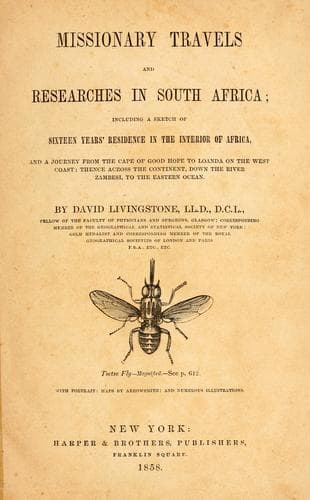
Missionary Travels and Researches in South AfricaLivingstone, David
Religion
Missionary Travels and Researches in South Africa
Livingstone, David
Missions -- South Africa; South Africa -- Description and travel
We passed great numbers of hippopotami. They are very numerous in the
parts of the river where they are never hunted. The males appear of a
dark color, the females of yellowish brown. There is not such a complete
separation of the sexes among them as among elephants. They spend most
of their time in the water, lolling about in a listless, dreamy manner.
When they come out of the river by night, they crop off the soft
succulent grasses very neatly. When they blow, they puff up the water
about three feet high.
Chapter 15.
Message to Masiko, the Barotse Chief, regarding the Captives--
Navigation of the Leeambye--Capabilities of this District--The
Leeba--Flowers and Bees--Buffalo-hunt--Field for a Botanist--Young
Alligators; their savage Nature--Suspicion of the Balonda--Sekelenke's
Present--A Man and his two Wives--Hunters--Message from Manenko,
a female Chief--Mambari Traders--A Dream--Sheakondo and his
People--Teeth-filing--Desire for Butter--Interview with Nyamoana,
another female Chief--Court Etiquette--Hair versus Wool--Increase of
Superstition--Arrival of Manenko; her Appearance and Husband--Mode
of Salutation--Anklets--Embassy, with a Present from Masiko--Roast
Beef--Manioc--Magic Lantern--Manenko an accomplished Scold: compels us
to wait--Unsuccessful Zebra-hunt.
On the 27th of December we were at the confluence of the Leeba and
Leeambye (lat. 14d 10' 52" S., long. 23d 35' 40" E.). Masiko, the
Barotse chief, for whom we had some captives, lived nearly due east of
this point. They were two little boys, a little girl, a young man, and
two middle-aged women. One of these was a member of a Babimpe tribe, who
knock out both upper and lower front teeth as a distinction. As we had
been informed by the captives on the previous Sunday that Masiko was in
the habit of seizing all orphans, and those who have no powerful friend
in the tribe whose protection they can claim, and selling them for
clothing to the Mambari, we thought the objection of the women to go
first to his town before seeing their friends quite reasonable, and
resolved to send a party of our own people to see them safely among
their relatives. I told the captive young man to inform Masiko that he
was very unlike his father Santuru, who had refused to sell his people
to Mambari. He will probably be afraid to deliver such a message
himself, but it is meant for his people, and they will circulate it
pretty widely, and Masiko may yet feel a little pressure from without.
We sent Mosantu, a Batoka man, and his companions, with the captives.
The Barotse whom we had were unwilling to go to Masiko, since they owe
him allegiance as the son of Santuru, and while they continue with the
Makololo are considered rebels. The message by Mosantu was, that "I was
sorry to find that Santuru had not borne a wiser son. Santuru loved to
govern men, but Masiko wanted to govern wild beasts only, as he sold
his people to the Mambari;" adding an explanation of the return of the
Public-domain text, read in full here on John Shaqi.
Reviews
Reviews
No reviews yet
Be the first to share your thoughts on this work.
Elsewhere in the archive
Join the Discussion
Join the discussion
Sign in to leave a comment or review.
Sign InorCreate an account