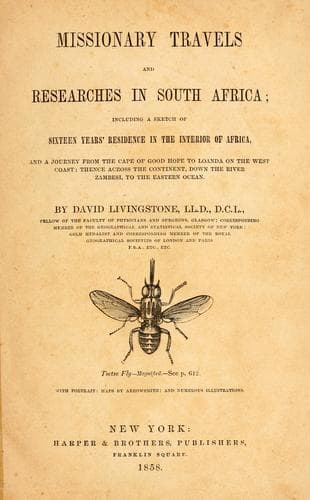
Missionary Travels and Researches in South AfricaLivingstone, David
Religion
Missionary Travels and Researches in South Africa
Livingstone, David
Missions -- South Africa; South Africa -- Description and travel
captives, and an injunction to him to live in peace, and prevent
his people kidnapping the children and canoes of the Makololo, as a
continuance in these deeds would lead to war, which I wished to prevent.
He was also instructed to say, if Masiko wanted fuller explanation of my
views, he must send a sensible man to talk with me at the first town of
the Balonda, to which I was about to proceed.
We ferried Mosantu over to the left bank of the Leeba. The journey
required five days, but it could not have been at a quicker rate than
ten or twelve miles per day; the children were between seven and eight
years of age, and unable to walk fast in a hot sun.
Leaving Mosantu to pursue his course, we shall take but one glance down
the river, which we are now about to leave, for it comes at this point
from the eastward, and our course is to be directed to the northwest,
as we mean to go to Loanda in Angola. From the confluence, where we now
are, down to Mosioatunya, there are many long reaches, where a vessel
equal to the Thames steamers plying between the bridges could run as
freely as they do on the Thames. It is often, even here, as broad as
that river at London Bridge, but, without accurate measurement of the
depth, one could not say which contained most water. There are, however,
many and serious obstacles to a continued navigation for hundreds of
miles at a stretch. About ten miles below the confluence of the Loeti,
for instance, there are many large sand-banks in the stream; then you
have a hundred miles to the River Simah, where a Thames steamer could
ply at all times of the year; but, again, the space between Simah and
Katima-molelo has five or six rapids with cataracts, one of which,
Gonye, could not be passed at any time without portage. Between these
rapids there are reaches of still, deep water, of several miles in
length. Beyond Katima-molelo to the confluence of the Chobe you have
nearly a hundred miles again, of a river capable of being navigated in
the same way as in the Barotse valley.
Now I do not say that this part of the river presents a very inviting
prospect for extemporaneous European enterprise; but when we have a
pathway which requires only the formation of portages to make it equal
to our canals for hundreds of miles, where the philosophers supposed
there was naught but an extensive sandy desert, we must confess that
the future partakes at least of the elements of hope. My deliberate
conviction was and is that the part of the country indicated is as
capable of supporting millions of inhabitants as it is of its thousands.
The grass of the Barotse valley, for instance, is such a densely-matted
mass that, when "laid", the stalks bear each other up, so that one feels
as if walking on the sheaves of a hay-stack, and the leches nestle under
it to bring forth their young. The soil which produces this, if placed
under the plow, instead of being mere pasturage, would yield grain
sufficient to feed vast multitudes.
Public-domain text, read in full here on John Shaqi.
Reviews
Reviews
No reviews yet
Be the first to share your thoughts on this work.
Elsewhere in the archive
Join the Discussion
Join the discussion
Sign in to leave a comment or review.
Sign InorCreate an account