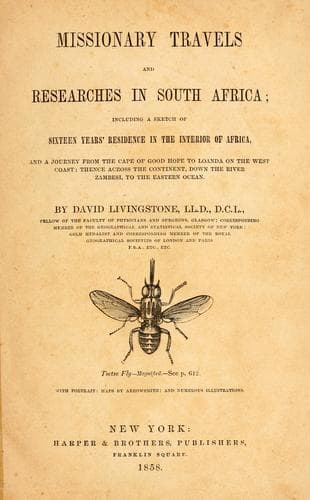
Missionary Travels and Researches in South AfricaLivingstone, David
Religion
Missionary Travels and Researches in South Africa
Livingstone, David
Missions -- South Africa; South Africa -- Description and travel
We now began to ascend the Leeba. The water is black in color as
compared with the main stream, which here assumes the name of Kabompo.
The Leeba flows placidly, and, unlike the parent river, receives numbers
of little rivulets from both sides. It winds slowly through the most
charming meadows, each of which has either a soft, sedgy centre, large
pond, or trickling rill down the middle. The trees are now covered with
a profusion of the freshest foliage, and seem planted in groups of such
pleasant, graceful outline that art could give no additional charm. The
grass, which had been burned off and was growing again after the
rains, was short and green, and all the scenery so like that of a
carefully-tended gentleman's park, that one is scarcely reminded that
the surrounding region is in the hands of simple nature alone. I suspect
that the level meadows are inundated annually, for the spots on which
the trees stand are elevated three or four feet above them, and these
elevations, being of different shapes, give the strange variety of
outline of the park-like woods. Numbers of a fresh-water shell are
scattered all over these valleys. The elevations, as I have observed
elsewhere, are of a soft, sandy soil, and the meadows of black, rich
alluvial loam. There are many beautiful flowers, and many bees to sip
their nectar. We found plenty of honey in the woods, and saw the stages
on which the Balonda dry their meat, when they come down to hunt and
gather the produce of the wild hives. In one part we came upon groups of
lofty trees as straight as masts, with festoons of orchilla-weed hanging
from the branches. This, which is used as a dye-stuff, is found nowhere
in the dry country to the south. It prefers the humid climate near the
west coast.
A large buffalo was wounded, and ran into the thickest part of the
forest, bleeding profusely. The young men went on his trail; and, though
the vegetation was so dense that no one could have run more than a few
yards, most of them went along quite carelessly, picking and eating
a fruit of the melon family called Mponko. When the animal heard them
approach he always fled, shifting his stand and doubling on his course
in the most cunning manner. In other cases I have known them to turn
back to a point a few yards from their own trail, and then lie down in
a hollow waiting for the hunter to come up. Though a heavy,
lumbering-looking animal, his charge is then rapid and terrific. More
accidents happen by the buffalo and the black rhinoceros than by the
lion. Though all are aware of the mischievous nature of the buffalo when
wounded, our young men went after him quite carelessly. They never lose
their presence of mind, but, as a buffalo charges back in a forest, dart
dexterously out of his way behind a tree, and, wheeling round, stab him
as he passes.
Public-domain text, read in full here on John Shaqi.
Reviews
Reviews
No reviews yet
Be the first to share your thoughts on this work.
Elsewhere in the archive
Join the Discussion
Join the discussion
Sign in to leave a comment or review.
Sign InorCreate an account