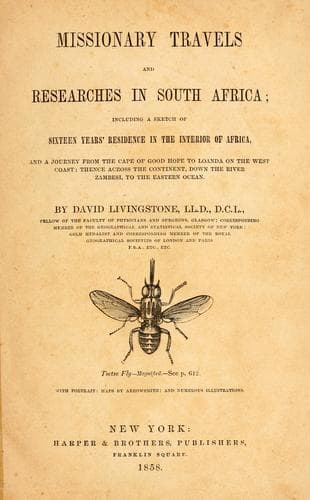
Missionary Travels and Researches in South AfricaLivingstone, David
Religion
Missionary Travels and Researches in South Africa
Livingstone, David
Missions -- South Africa; South Africa -- Description and travel
The country is furnished largely with forest, having occasionally open
lawns covered with grass, not in tufts as in the south, but so closely
planted that one can not see the soil. We came upon a man and his two
wives and children, burning coarse rushes and the stalks of tsitla,
growing in a brackish marsh, in order to extract a kind of salt from the
ashes. They make a funnel of branches of trees, and line it with grass
rope, twisted round until it is, as it were, a beehive-roof inverted.
The ashes are put into water, in a calabash, and then it is allowed to
percolate through the small hole in the bottom and through the grass.
When this water is evaporated in the sun, it yields sufficient salt to
form a relish with food. The women and children fled with precipitation,
but we sat down at a distance, and allowed the man time to gain courage
enough to speak. He, however, trembled excessively at the apparition
before him; but when we explained that our object was to hunt game, and
not men, he became calm, and called back his wives. We soon afterward
came to another party on the same errand with ourselves. The man had a
bow about six feet long, and iron-headed arrows about thirty inches in
length; he had also wooden arrows neatly barbed, to shoot in cases
where he might not be quite certain of recovering them again. We soon
afterward got a zebra, and gave our hunting acquaintances such a liberal
share that we soon became friends. All whom we saw that day then came
with us to the encampment to beg a little meat; and as they have so
little salt, I have no doubt they felt grateful for what we gave.
Sekelenke and his people, twenty-four in number, defiled past our camp
carrying large bundles of dried elephants' meat. Most of them came to
say good-by, and Sekelenke himself sent to say that he had gone to visit
a wife living in the village of Manenko. It was a mere African manoeuvre
to gain information, and not commit himself to either one line of action
or another with respect to our visit. As he was probably in the party
before us, I replied that it was all right, and when my people came up
from Masiko I would go to my wife too. Another zebra came to our camp,
and, as we had friends near, it was shot. It was the 'Equus montanus',
though the country is perfectly flat, and was finely marked down to the
feet, as all the zebras are in these parts.
To our first message, offering a visit of explanation to Manenko, we got
an answer, with a basket of manioc roots, that we must remain where we
were till she should visit us. Having waited two days already for her,
other messengers arrived with orders for me to come to her. After four
days of rains and negotiation, I declined going at all, and proceeded
up the river to the small stream Makondo (lat. 13d 23' 12" S.), which
enters the Leeba from the east, and is between twenty and thirty yards
broad.
Public-domain text, read in full here on John Shaqi.
Reviews
Reviews
No reviews yet
Be the first to share your thoughts on this work.
Elsewhere in the archive
Join the Discussion
Join the discussion
Sign in to leave a comment or review.
Sign InorCreate an account