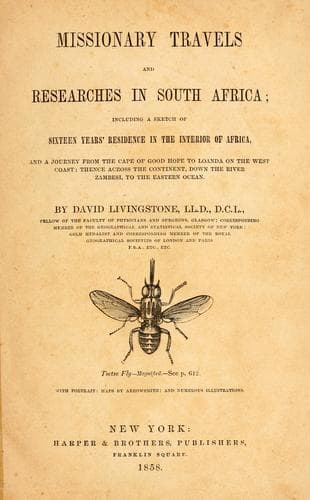
Missionary Travels and Researches in South AfricaLivingstone, David
Religion
Missionary Travels and Researches in South Africa
Livingstone, David
Missions -- South Africa; South Africa -- Description and travel
JANUARY 1ST, 1854. We had heavy rains almost every day; indeed, the
rainy season had fairly set in. Baskets of the purple fruit called mawa
were frequently brought to us by the villagers; not for sale, but from a
belief that their chiefs would be pleased to hear that they had treated
us well; we gave them pieces of meat in return.
When crossing at the confluence of the Leeba and Makondo, one of my men
picked up a bit of a steel watch-chain of English manufacture, and we
were informed that this was the spot where the Mambari cross in
coming to Masiko. Their visits explain why Sekelenke kept his tusks so
carefully. These Mambari are very enterprising merchants: when they mean
to trade with a town, they deliberately begin the affair by building
huts, as if they knew that little business could be transacted without a
liberal allowance of time for palaver. They bring Manchester goods into
the heart of Africa; these cotton prints look so wonderful that the
Makololo could not believe them to be the work of mortal hands. On
questioning the Mambari they were answered that English manufactures
came out of the sea, and beads were gathered on its shore. To Africans
our cotton mills are fairy dreams. "How can the irons spin, weave, and
print so beautifully?" Our country is like what Taprobane was to our
ancestors--a strange realm of light, whence came the diamond, muslin,
and peacocks; an attempt at explanation of our manufactures usually
elicits the expression, "Truly ye are gods!"
When about to leave the Makondo, one of my men had dreamed that Mosantu
was shut up a prisoner in a stockade: this dream depressed the spirits
of the whole party, and when I came out of my little tent in the
morning, they were sitting the pictures of abject sorrow. I asked if
we were to be guided by dreams, or by the authority I derived from
Sekeletu, and ordered them to load the boats at once; they seemed
ashamed to confess their fears; the Makololo picked up courage and
upbraided the others for having such superstitious views, and said this
was always their way; if even a certain bird called to them, they would
turn back from an enterprise, saying it was unlucky. They entered the
canoes at last, and were the better of a little scolding for being
inclined to put dreams before authority. It rained all the morning,
but about eleven we reached the village of Sheakondo, on a small stream
named Lonkonye. We sent a message to the head man, who soon appeared
with two wives, bearing handsome presents of manioc: Sheakondo could
speak the language of the Barotse well, and seemed awestruck when told
some of the "words of God". He manifested no fear, always spoke frankly,
and when he made an asseveration, did so by simply pointing up to the
sky above him. The Balonda cultivate the manioc or cassava extensively;
also dura, ground-nuts, beans, maize, sweet potatoes, and yams, here
called "lekoto", but as yet we see only the outlying villages.
Public-domain text, read in full here on John Shaqi.
Reviews
Reviews
No reviews yet
Be the first to share your thoughts on this work.
Elsewhere in the archive
Join the Discussion
Join the discussion
Sign in to leave a comment or review.
Sign InorCreate an account