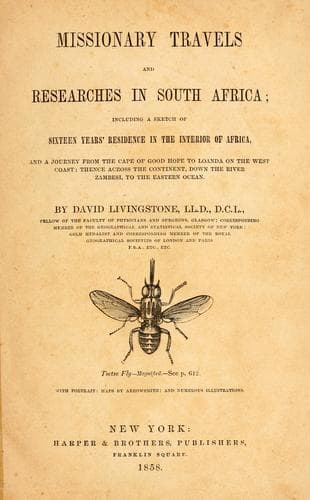
Missionary Travels and Researches in South AfricaLivingstone, David
Religion
Missionary Travels and Researches in South Africa
Livingstone, David
Missions -- South Africa; South Africa -- Description and travel
They mention ten kinds of fish in their river; and, in their songs of
praise to the Zouga, say, "The messenger sent in haste is always forced
to spend the night on the way by the abundance of food you place before
him." The Bayeiye live much on fish, which is quite an abomination to
the Bechuanas of the south; and they catch them in large numbers by
means of nets made of the fine, strong fibres of the hibiscus, which
grows abundantly in all moist places. Their float-ropes are made of
the ife, or, as it is now called, the 'Sanseviere Angolensis', a
flag-looking plant, having a very strong fibre, that abounds from
Kolobeng to Angola; and the floats themselves are pieces of a
water-plant containing valves at each joint, which retain the air in
cells about an inch long. The mode of knotting the nets is identical
with our own.
They also spear the fish with javelins having a light handle, which
readily floats on the surface. They show great dexterity in harpooning
the hippopotamus; and, the barbed blade of the spear being attached to
a rope made of the young leaves of the palmyra, the animal can not
rid himself of the canoe, attached to him in whale fashion, except by
smashing it, which he not unfrequently does by his teeth or by a stroke
of his hind foot.
On returning to the Bakurutse, we found that their canoes for fishing
were simply large bundles of reeds tied together. Such a canoe would
be a ready extemporaneous pontoon for crossing any river that had reedy
banks.
Chapter 4.
Leave Kolobeng again for the Country of Sebituane--Reach the Zouga--
The Tsetse--A Party of Englishmen--Death of Mr. Rider--Obtain
Guides--Children fall sick with Fever--Relinquish the Attempt to reach
Sebituane--Mr. Oswell's Elephant-hunting--Return to Kolobeng--Make
a third Start thence--Reach Nchokotsa--Salt-pans--"Links", or
Springs--Bushmen--Our Guide Shobo--The Banajoa--An ugly Chief--The
Tsetse--Bite fatal to domestic Animals, but harmless to wild Animals
and Man--Operation of the Poison--Losses caused by it--The Makololo--
Our Meeting with Sebituane--Sketch of his Career--His Courage and
Conquests--Manoeuvres of the Batoka--He outwits them--His Wars with
the Matebele--Predictions of a native Prophet--Successes of the
Makololo--Renewed Attacks of the Matebele--The Island of Loyelo--Defeat
of the Matebele--Sebituane's Policy--His Kindness to Strangers and to
the Poor--His sudden Illness and Death--Succeeded by his Daughter--Her
Friendliness to us--Discovery, in June, 1851, of the Zambesi flowing
in the Centre of the Continent--Its Size--The Mambari--The
Slave-trade--Determine to send Family to England--Return to the Cape
in April, 1852--Safe Transit through the Caffre Country during
Hostilities--Need of a "Special Correspondent"--Kindness of the London
Missionary Society--Assistance afforded by the Astronomer Royal at the
Cape.
Public-domain text, read in full here on John Shaqi.
Reviews
Reviews
No reviews yet
Be the first to share your thoughts on this work.
Elsewhere in the archive
Join the Discussion
Join the discussion
Sign in to leave a comment or review.
Sign InorCreate an account