Missionary Travels and Researches in South AfricaLivingstone, David
Religion
Missionary Travels and Researches in South Africa
Livingstone, David
Missions -- South Africa; South Africa -- Description and travel
Having returned to Kolobeng, I remained there till April, 1850, and then
left in company with Mrs. Livingstone, our three children, and the chief
Sechele--who had now bought a wagon of his own--in order to go across
the Zouga at its lower end, with the intention of proceeding up the
northern bank till we gained the Tamunak'le, and of then ascending that
river to visit Sebituane in the north. Sekomi had given orders to fill
up the wells which we had dug with so much labor at Serotli, so we took
the more eastern route through the Bamangwato town and by Letloche. That
chief asked why I had avoided him in our former journeys. I replied that
my reason was that I knew he did not wish me to go to the lake, and I
did not want to quarrel with him. "Well," he said, "you beat me then,
and I am content."
Parting with Sechele at the ford, as he was eager to visit Lechulatebe,
we went along the northern woody bank of the Zouga with great labor,
having to cut down very many trees to allow the wagons to pass. Our
losses by oxen falling into pitfalls were very heavy. The Bayeiye kindly
opened the pits when they knew of our approach; but when that was not
the case, we could blame no one on finding an established custom of the
country inimical to our interests. On approaching the confluence of the
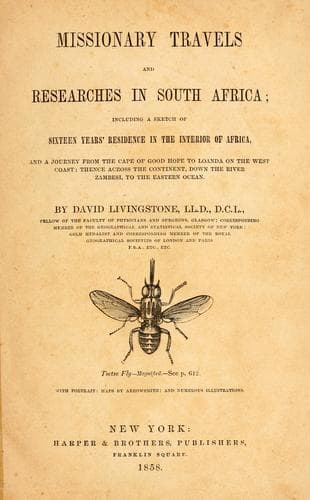
Tamunak'le we were informed that the fly called tsetse* abounded on its
banks. This was a barrier we never expected to meet; and, as it might
have brought our wagons to a complete stand-still in a wilderness, where
no supplies for the children could be obtained, we were reluctantly
compelled to recross the Zouga.
* 'Glossina morsitans', the first specimens of which were
brought to England in 1848 by my friend Major Vardon, from the
banks of the Limpopo.
From the Bayeiye we learned that a party of Englishmen, who had come to
the lake in search of ivory, were all laid low by fever, so we traveled
hastily down about sixty miles to render what aid was in our power.
We were grieved to find, as we came near, that Mr. Alfred Rider, an
enterprising young artist who had come to make sketches of this country
and of the lake immediately after its discovery, had died of fever
before our arrival; but by the aid of medicines and such comforts as
could be made by the only English lady who ever visited the lake, the
others happily recovered. The unfinished drawing of Lake Ngami was made
by Mr. Rider just before his death, and has been kindly lent for this
work by his bereaved mother.
Public-domain text, read in full here on John Shaqi.
Reviews
Reviews
No reviews yet
Be the first to share your thoughts on this work.
Elsewhere in the archive
Join the Discussion
Join the discussion
Sign in to leave a comment or review.
Sign InorCreate an account