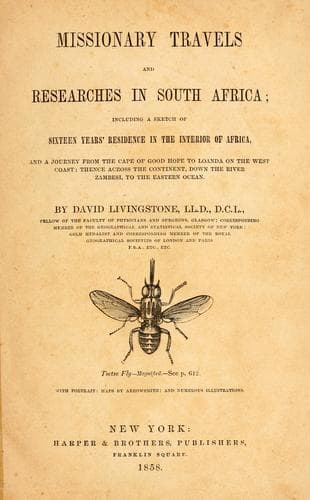
Missionary Travels and Researches in South AfricaLivingstone, David
Religion
Missionary Travels and Researches in South Africa
Livingstone, David
Missions -- South Africa; South Africa -- Description and travel
The Makololo whom we met on the Chobe were delighted to see us; and as
their chief Sebituane was about twenty miles down the river, Mr. Oswell
and I proceeded in canoes to his temporary residence. He had come from
the Barotse town of Naliele down to Sesheke as soon as he heard of white
men being in search of him, and now came one hundred miles more to
bid us welcome into his country. He was upon an island, with all his
principal men around him, and engaged in singing when we arrived. It
was more like church music than the sing-song ee ee ee, ae ae ae, of
the Bechuanas of the south, and they continued the tune for some
seconds after we approached. We informed him of the difficulties we had
encountered, and how glad we were that they were all at an end by at
last reaching his presence. He signified his own joy, and added, "Your
cattle are all bitten by the tsetse, and will certainly die; but never
mind, I have oxen, and will give you as many as you need." We, in our
ignorance, then thought that as so few tsetse had bitten them no great
mischief would follow. He then presented us with an ox and a jar of
honey as food, and handed us over to the care of Mahale, who had headed
the party to Kolobeng, and would now fain appropriate to himself the
whole credit of our coming. Prepared skins of oxen, as soft as cloth,
were given to cover us through the night; and, as nothing could be
returned to this chief, Mahale became the owner of them. Long before it
was day Sebituane came, and sitting down by the fire, which was
lighted for our benefit behind the hedge where we lay, he narrated the
difficulties he had himself experienced, when a young man, in crossing
that same desert which we had mastered long afterward. As he has been
most remarkable in his career, and was unquestionably the greatest man
in all that country, a short sketch of his life may prove interesting to
the reader.
Sebituane was about forty-five years of age; of a tall and wiry form,
an olive or coffee-and-milk color, and slightly bald; in manner cool
and collected, and more frank in his answers than any other chief I ever
met. He was the greatest warrior ever heard of beyond the colony; for,
unlike Mosilikatse, Dingaan, and others, he always led his men
into battle himself. When he saw the enemy, he felt the edge of his
battle-axe, and said, "Aha! it is sharp, and whoever turns his back on
the enemy will feel its edge." So fleet of foot was he, that all his
people knew there was no escape for the coward, as any such would be
cut down without mercy. In some instances of skulking he allowed the
individual to return home; then calling him, he would say, "Ah! you
prefer dying at home to dying in the field, do you? You shall have your
desire." This was the signal for his immediate execution.
Public-domain text, read in full here on John Shaqi.
Reviews
Reviews
No reviews yet
Be the first to share your thoughts on this work.
Elsewhere in the archive
Join the Discussion
Join the discussion
Sign in to leave a comment or review.
Sign InorCreate an account