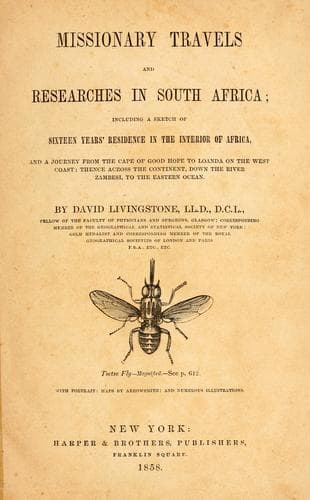
Missionary Travels and Researches in South AfricaLivingstone, David
Religion
Missionary Travels and Researches in South Africa
Livingstone, David
Missions -- South Africa; South Africa -- Description and travel
He came from the country near the sources of the Likwa and Namagari
rivers in the south, so we met him eight hundred or nine hundred miles
from his birth-place. He was not the son of a chief, though related
closely to the reigning family of the Basutu; and when, in an attack by
Sikonyele, the tribe was driven out of one part, Sebituane was one in
that immense horde of savages driven back by the Griquas from Kuruman in
1824.* He then fled to the north with an insignificant party of men and
cattle. At Melita the Bangwaketse collected the Bakwains, Bakatla, and
Bahurutse, to "eat them up". Placing his men in front, and the women
behind the cattle, he routed the whole of his enemies at one blow.
Having thus conquered Makabe, the chief of the Bangwaketse, he took
immediate possession of his town and all his goods.
* See an account of this affair in Moffat's "Missionary
Enterprise in Africa".
Sebituane subsequently settled at the place called Litubaruba, where
Sechele now dwells, and his people suffered severely in one of those
unrecorded attacks by white men, in which murder is committed and
materials laid up in the conscience for a future judgment.
A great variety of fortune followed him in the northern part of the
Bechuana country; twice he lost all his cattle by the attacks of the
Matabele, but always kept his people together, and retook more than he
lost. He then crossed the Desert by nearly the same path that we did.
He had captured a guide, and, as it was necessary to travel by night in
order to reach water, the guide took advantage of this and gave him the
slip. After marching till morning, and going as they thought right,
they found themselves on the trail of the day before. Many of his
cattle burst away from him in the phrensy of thirst, and rushed back
to Serotli, then a large piece of water, and to Mashue and Lopepe, the
habitations of their original owners. He stocked himself again among the
Batletli, on Lake Kumadau, whose herds were of the large-horned species
of cattle.* Conquering all around the lake, he heard of white men living
at the west coast; and, haunted by what seems to have been the dream
of his whole life, a desire to have intercourse with the white man, he
passed away to the southwest, into the parts opened up lately by Messrs.
Galton and Andersson. There, suffering intensely from thirst, he and
his party came to a small well. He decided that the men, not the cattle,
should drink it, the former being of most value, as they could fight
for more should these be lost. In the morning they found the cattle had
escaped to the Damaras.
* We found the Batauana in possession of this breed when we
discovered Lake Ngami. One of these horns, brought to England
by Major Vardon, will hold no less than twenty-one imperial
pints of water; and a pair, brought by Mr. Oswell, and now in
the possession of Colonel Steele, measures from tip to tip
eight and a half feet.
Public-domain text, read in full here on John Shaqi.
Reviews
Reviews
No reviews yet
Be the first to share your thoughts on this work.
Elsewhere in the archive
Join the Discussion
Join the discussion
Sign in to leave a comment or review.
Sign InorCreate an account