There was issuing from this garden a river that was parted into four
heads. The first of these, Pison, compassed the whole land of Havilah,
the second, Gihon, that compassed the whole land of Ethiopia, the third,
Heddekel, that flowed toward the east of Assyria, and the fourth, the
Euphrates. Where are these four rivers now? The brave prow of discovery
has visited every sea; the traveler has pressed with weary feet the soil
of every clime; and yet there has been found no place from which four
rivers sprang. The Euphrates still journeys to the gulf, but where are
Pison, Gihon and the mighty Heddekel? Surely by going to the source
of the Euphrates we ought to find either these three rivers or their
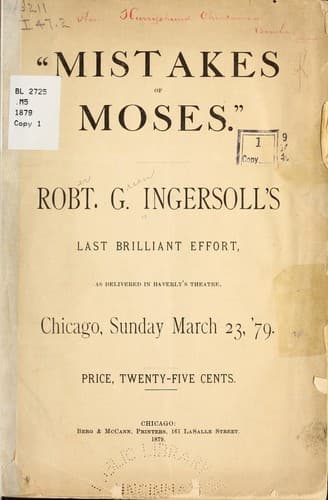
ancient beds. Will some minister when he answers the "Mistakes of
Moses" tell us where these rivers are or were? The maps of the world are
incomplete without these mighty streams. We have discovered the sources
of the Nile; the North Pole will soon be touched by an American; but
these three rivers still rise in unknown hills, still flow through
unknown lands, and empty still in unknown seas.
The account of these four rivers is what the Rev. David Swing would call
"a geographical poem." The orthodox clergy cover the whole affair with
the blanket of allegory, while the "scientific" christian folks talk
about cataclysms, upheavals, earthquakes, and vast displacements of the
earth's crust.
The question, then arises, whether within the last six thousand years
there have been such upheavals and displacements? Talk as you will about
the vast "creative periods" that preceded the appearance of man; it
is, according to the bible, only about six thousand years since man was
created. Moses gives us the generations of men from Adam until his day,
and this account cannot be explained away by calling centuries, days.
According to the second account of creation, these four rivers were
made after the creation of man, and consequently they must have been
obliterated by convulsions of Nature within six thousand years.
Can we not account for these contradictions, absurdities, and falsehoods
by simply saying that although the writer may have done his level best,
he failed because he was limited in knowledge, led away by tradition,
and depended too implicitly upon the correctness of his imagination?
Is not such a course far more reasonable than to insist that all these
things are true and must stand though every science shall fall to mental
dust?
Public-domain text, read in full here on John Shaqi.
Reviews
Reviews
No reviews yet
Be the first to share your thoughts on this work.
Join the Discussion
Join the discussion
Sign in to leave a comment or review.
Sign InorCreate an account