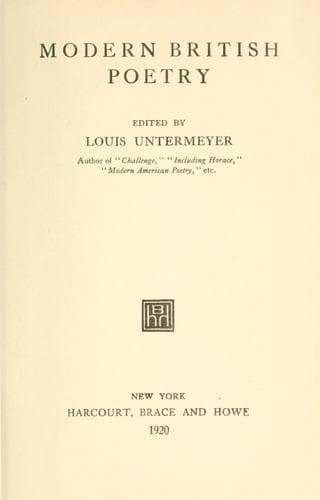
English poetry -- 19th century; English poetry -- 20th century
Smart lad, to slip betimes away
From fields where glory does not stay,
And early though the laurel grows
It withers quicker than the rose.
Eyes the shady night has shut
Cannot see the record cut,
And silence sounds no worse than cheers
After earth has stopped the ears:
Now you will not swell the rout
Of lads that wore their honours out,
Runners whom renown outran
And the name died before the man.
So set, before its echoes fade,
The fleet foot on the sill of shade,
And hold to the low lintel up
The still-defended challenge-cup.
And round that early-laurelled head
Will flock to gaze the strengthless dead,
And find unwithered on its curls
The garland briefer than a girl's.
"LOVELIEST OF TREES"
Loveliest of trees, the cherry now
Is hung with bloom along the bough,
And stands about the woodland ride
Wearing white for Eastertide.
Now, of my threescore years and ten,
Twenty will not come again,
And take from seventy springs a score,
It only leaves me fifty more.
And since to look at things in bloom
Fifty springs are little room,
About the woodlands I will go
To see the cherry hung with snow.
_Douglas Hyde_
Doctor Douglas Hyde was born in Roscommon County, Ireland in, as
nearly as can be ascertained, 1860. One of the most brilliant Irish
scholars of his day, he has worked indefatigably for the cause of his
native letters. He has written a comprehensive history of Irish
literature; has compiled, edited and translated into English the _Love
Songs of Connaught_; is President of The Irish National Literary
Society; and is the author of innumerable poems in Gaelic--far more
than he ever wrote in English. His collections of Irish folk-lore and
poetry were among the most notable contributions to the Celtic
revival; they were (see Preface), to a large extent, responsible for
it. Since 1909 he has been Professor of Modern Irish in University
College, Dublin.
The poem which is here quoted is one of his many brilliant and
reanimating translations. In its music and its peculiar rhyme-scheme,
it reproduces the peculiar flavor as well as the meter of the West
Irish original.
I SHALL NOT DIE FOR THEE
For thee, I shall not die,
Woman of high fame and name;
Foolish men thou mayest slay
I and they are not the same.
Why should I expire
For the fire of an eye,
Slender waist or swan-like limb,
Is't for them that I should die?
The round breasts, the fresh skin,
Cheeks crimson, hair so long and rich;
Indeed, indeed, I shall not die,
Please God, not I, for any such.
The golden hair, the forehead thin,
The chaste mien, the gracious ease,
The rounded heel, the languid tone,--
Fools alone find death from these.
Public-domain text, read in full here on John Shaqi.
Reviews
Reviews
No reviews yet
Be the first to share your thoughts on this work.
Join the Discussion
Join the discussion
Sign in to leave a comment or review.
Sign InorCreate an account