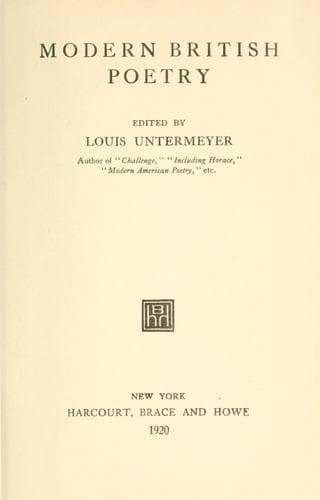
English poetry -- 19th century; English poetry -- 20th century
Born in 1867, Lionel Johnson received a classical education at Oxford,
and his poetry is a faithful reflection of his studies in Greek and
Latin literatures. Though he allied himself with the modern Irish
poets, his Celtic origin is a literary myth; Johnson, having been
converted to Catholicism in 1891, became imbued with Catholic and,
later, with Irish traditions. His verse, while sometimes strained and
over-decorated, is chastely designed, rich and, like that of the
Cavalier poets of the seventeenth century, mystically devotional.
_Poems_ (1895) contains his best work. Johnson died in 1902.
MYSTIC AND CAVALIER
Go from me: I am one of those who fall.
What! hath no cold wind swept your heart at all,
In my sad company? Before the end,
Go from me, dear my friend!
Yours are the victories of light: your feet
Rest from good toil, where rest is brave and sweet:
But after warfare in a mourning gloom,
I rest in clouds of doom.
Have you not read so, looking in these eyes?
Is it the common light of the pure skies,
Lights up their shadowy depths? The end is set:
Though the end be not yet.
When gracious music stirs, and all is bright,
And beauty triumphs through a courtly night;
When I too joy, a man like other men:
Yet, am I like them, then?
And in the battle, when the horsemen sweep
Against a thousand deaths, and fall on sleep:
Who ever sought that sudden calm, if I
Sought not? yet could not die!
Seek with thine eyes to pierce this crystal sphere:
Canst read a fate there, prosperous and clear?
Only the mists, only the weeping clouds,
Dimness and airy shrouds.
Beneath, what angels are at work? What powers
Prepare the secret of the fatal hours?
See! the mists tremble, and the clouds are stirred:
When comes the calling word?
The clouds are breaking from the crystal ball,
Breaking and clearing: and I look to fall.
When the cold winds and airs of portent sweep,
My spirit may have sleep.
O rich and sounding voices of the air!
Interpreters and prophets of despair:
Priests of a fearful sacrament! I come,
To make with you mine home.
TO A TRAVELLER
The mountains, and the lonely death at last
Upon the lonely mountains: O strong friend!
The wandering over, and the labour passed,
Thou art indeed at rest:
Earth gave thee of her best,
That labour and this end.
Earth was thy mother, and her true son thou:
Earth called thee to a knowledge of her ways,
Upon the great hills, up the great streams: now
Upon earth's kindly breast
Thou art indeed at rest:
Thou, and thine arduous days.
Public-domain text, read in full here on John Shaqi.
Reviews
Reviews
No reviews yet
Be the first to share your thoughts on this work.
Join the Discussion
Join the discussion
Sign in to leave a comment or review.
Sign InorCreate an account