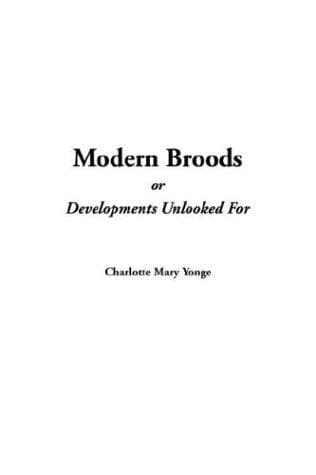
Modern Broods; Or, Developments Unlooked ForYonge, Charlotte M. (Charlotte Mary)
General
Modern Broods; Or, Developments Unlooked For
Yonge, Charlotte M. (Charlotte Mary)
Domestic fiction; England -- Social life and customs -- 19th century -- Fiction; English fiction
“Don’t come in that way, Flapsy!” called Paula. “You’ll be heard in the
dining-room, and the M.A. will tremble at your dusty feet.”
“They aren’t dusty,” said Vera, pulling up the blind with a clatter.
“Aren’t they?” laughed Paula, pointing.
“You had better go and wipe them,” said Agatha.
“I don’t believe in M.A.’s fidgets,” returned Vera.
“But I do, in proper deference to the head of the house,” said Agatha,
gravely.
“Murder in Irish!” cried Vera, bouncing away, while Paula argued,
“Really, Nag, life is not long enough to attend to all the M.A.’s little
worries.”
“Polly, dear, I am afraid we have been on a wrong tack with our sister.
I don’t like calling her by that name.”
“You began it!” exclaimed Vera, dashing in by the door as she spoke.
“I could not have meant it as a nickname to be always in use.”
“Oh yes, you did, I remember”—and an argument was beginning, which Agatha
cut short by saying, “Any way, it is bad taste.”
“Nag has been so much among the real M.A. that she is tender about their
title.”
“She wants to be one herself,” said Vera; “and so she will if she goes on
getting learned and faddy.”
“In both senses?” said Paula.
Agatha laughed a little, but added, “No, Polly, the thing is that it is
hardly kind or right to put that sort of label upon a person like
Magdalen—who has done so much for us—and—”
The perverse young hearts could not bear a touch on the chord of
gratitude; and Paula burst in, “Label or libel, do you mean?”
“It becomes a libel as you use it.”
“Do you want us to call her sister or Magdalen, the whole scriptural
mouthful at once?”
“I believe that to call her Magdalen or Maidie, as my father did, would
make her feel nearer to us than the formal way of saying ‘Sister.’”
“I don’t mind about changing,” said Paula. “She can never be the same to
us as dear Sister Mena.”
“She is so tiresome,” added Vera. “She bothers so over my music; calling
out if I make ever so small a slip, and making me go over all again.”
“Well she may,” said Paula. “She is making little Tick play so nicely.
Just listen! But I can’t bear her dragging us off to that horrid old
Arnscombe Church and the nasty stuffy Sunday school.”
“That reminds me,” said Agatha; “Gillian Merrifield met a relation of Mr.
Earl’s, who said that Miss Prescott had brought quite new life and spirit
to the poor old man, who had been getting quite out of heart for want of
any one to help and sympathise with him.”
“Then he ought to make his services more Catholic,” said Paula. “But
nothing will wean her from the old parochial idea. Why, she would not
let me give my winter stockings to Sister Beata’s poor girls, but made me
darn them and put them by.”
“Yes, and mine, which were bad enough to give away, she made me darn
first,” cried Vera. “She is ever so much worse than the superlative
about mending one’s clothes.”
“There ought to be another degree of comparison,” said
Paula,—“Botheratissima!”
Public-domain text, read in full here on John Shaqi.
Reviews
Reviews
No reviews yet
Be the first to share your thoughts on this work.
Join the Discussion
Join the discussion
Sign in to leave a comment or review.
Sign InorCreate an account