CHAPTER PAGE
I.--+Introduction+ 1
II.--+John Amos Comenius+ (1592-1670) 18
III.--+John Locke+ (1632-1704) 35
IV.--+Jean Jacques Rousseau+ (1712-1778) 59
V.--+Basedow and Kant+
Johann Bernard Basedow (1723-1790) 93
Immanuel Kant (1724-1804) 98
VI.--+Heinrich Pestalozzi+ (1746-1826) 116
VII.--+Johann Gottlieb Fichte+ (1762-1814) 143
VIII.--+Friedrich Froebel+ (1782-1852) 166
IX.--+Johann Friedrich Herbart+ (1776-1841) 199
X.--+Herbert Spencer+ (1820-1903) 223
XI.--+Georg Wilhelm Friedrich Hegel+ (1770-1831) 245
XII.--+W. T. Harris and G. Stanley Hall+
William Torrey Harris (1835-1909) 267
Granville Stanley Hall (1844-1924) 276
+Index+ 295
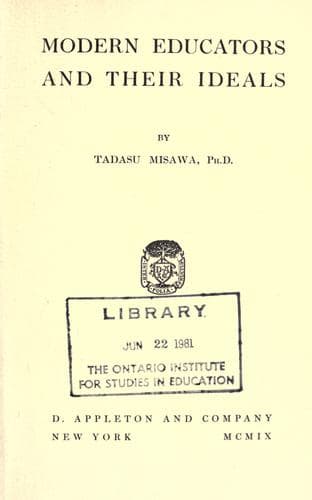
MODERN EDUCATORS AND
THEIR IDEALS
CHAPTER I.
INTRODUCTION
The Ægean peninsula was the great reservoir of ancient civilization
into which the cultural stream of every nation around the Mediterranean
had its outlet and from which all subsequent ages of Europe have drawn.
Therefore without an understanding of the Greek ideas and ideals of
education we shall not be able to understand the European ideas and
ideals of education. As Compayré says, “in respect to education, as in
respect to everything else, the higher spiritual life of modern nations
has been developed under the influence of Grecian antiquity” (5: p.
18). And we can safely say that, with the exception of the ancient
Chinese--so misunderstood and misrepresented in the West, but the Greek
of the Orient in my opinion--no nation in antiquity represents modern
conceptions so nearly as the Greek, especially the Athenian.
The complete and harmonious development of the human body and soul
in their strength and beauty; the perfect and full, yet regulated
enjoyment of earthly life in its social as well as individual form; the
attainment of virtue and happiness in and through the state--these were
the fundamental ideals which governed the ancient Greeks. The state not
only took nearly the sole charge of the education of its citizens, but
it was in itself the educational and educative institution. People were
educated through their social and communal life. The part played by the
school was very small; it had a later and private origin, beginning
with the rhetoricians and philosophers, and meeting the need of the few.
Public-domain text, read in full here on John Shaqi.
Reviews
Reviews
No reviews yet
Be the first to share your thoughts on this work.
Join the Discussion
Join the discussion
Sign in to leave a comment or review.
Sign InorCreate an account