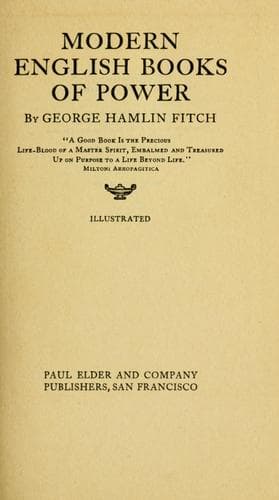
English literature -- 19th century -- History and criticism
But much as he liked his literary work, Scott would not have produced
so great a number of fine novels had he not been impelled by the
desire to retrieve large money losses. His old school friend,
Ballantyne, forced into bankruptcy the printing firm in which Scott
was a secret partner. The novelist was not morally responsible for
these debts, but his keen sense of honor made him accept all the
responsibility, and it drove him to that unceasing work which
shortened his life. He paid off nearly all the great debt, and he gave
in this task an example of high courage and power of work that has
never been surpassed and seldom equaled. You may read the record of
those last years in Lockhart's fine _Life of Scott_. Get the one
volume edition, for the full work is too long for these busy days, and
follow the old author in his heroic struggle. It will bring tears to
your eyes, but it will make you a lover of Scott, the man, who was as
great as Scott, the poet and novelist.
Ruskin, when he was making up a list of great authors, put opposite
Scott's name, "Every line." That bit of advice cannot be followed in
these strenuous times, but one must make a selection of the best, and
then, if he have time and inclination, add to this number. To my mind,
the four great novels of Scott are _Ivanhoe_, _Quentin Durward_, _The
Talisman_ and _The Heart of Midlothian_. The first gives you feudal
England as no one else has painted it, with a picture of Richard the
Lion-Hearted which no historian has ever approached. It contains some
of the most thrilling scenes in all fiction.
James Payn, who was a very clever novelist, relates the story that he
and two literary friends agreed to name the scene in all fiction that
they regarded as the most dramatic. When they came to compare notes
they found that all three had chosen the same--the entry of the
unknown knight at Ashby de la Zouch, who passes by the tents of the
other contestants and strikes with a resounding clash the shield of
the haughty Templar. This romance also contains one of Scott's finest
women, the Jewess Rebecca, who atones for the novelist's many insipid
female characters. Scott was much like Stevenson--he preferred to draw
men, and he was happiest when in the clash of arms or about to
undertake a desperate adventure.
_Quentin Durward_ is memorable for its splendid picture of Louis XI,
one of the ablest as well as one of the meanest men who ever sat on a
throne. The early chapters of this novel, which describe the
adventures of the young Scotch soldier at the court of France, have
never been surpassed in romantic interest. _The Talisman_ gives the
glory and the romance of the Crusades as no other imaginative work has
done. It stands in a class by itself and is only approached by Scott's
last novel, _Count Robert of Paris_, which gives flashes of the same
spirit.
Public-domain text, read in full here on John Shaqi.
Reviews
Reviews
No reviews yet
Be the first to share your thoughts on this work.
Join the Discussion
Join the discussion
Sign in to leave a comment or review.
Sign InorCreate an account