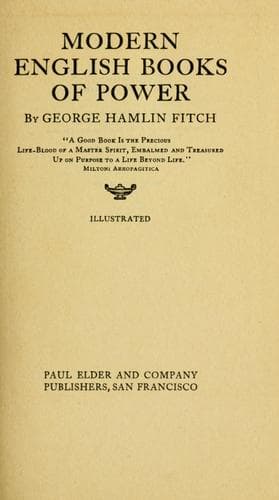
English literature -- 19th century -- History and criticism
It ought not to disturb any reader that Defoe turns aside and gives
reflections on the acts of his characters, for these remarks are the
fruit of his own knowledge of the world. In the same way Thackeray
keeps up a running comment on his men and women, and these bits of
philosophy make his novels a storehouse of apothegms, which may be
read again and again with great profit and pleasure. The modern novel,
with its comparative lack of thought and feeling, its insistence
upon the absolute effacement of the author, is seldom worth reading a
second time. Not so with Thackeray. Every reading reveals new beauties
of thought or style. An entire book has been made up of brief extracts
from Thackeray's novels, and it is an ideal little volume for a pocket
companion on walks, as Thackeray fits into any mood and always gives
one material for thought.
[Illustration: WILLIAM MAKEPEACE THACKERAY A CARICATURE DRAWN BY
HIMSELF]
Of all Thackeray's novels _Vanity Fair_ is the best known and most
popular. It is a remarkable picture of a thoroughly hard, selfish
woman whom even motherhood did not soften; but it is something more
than the chronicle of Becky Sharp's fortunes. It is a panoramic sketch
of many phases of London life; it is the free giving out by a great
master of fiction of his impressions of life. Hence _Vanity Fair_
alone is worth a hundred books filled merely with exciting adventures,
which do not make the reader think. The problems that Thackeray
presents in his masterpiece are those of love, duty, self-sacrifice;
of high aims and many temptations to fall below those aspirations; of
sordid, selfish life, and of fine, noble, generous souls who light up
the world and make it richer by their presence.
Thackeray, in _Vanity Fair_, has sixty characters, yet each is drawn
sharply and clearly, and the whole story moves on with the ease of
real life. Consummate art is shown in the painting of Becky's gradual
rise to power and the great scene at the climax of her success, when
Rawdon Crawley strikes down the Marquis of Steyne, is one of the
finest in all fiction. Though Becky knows that this blow shatters her
social edifice, she is still woman enough to admire her husband in the
very act that marks the beginning of the decadence of her fortunes.
_Vanity Fair_, read carefully a half-dozen times, is a liberal
education in life and in the art of the novelist.
Personally, I rank _Pendennis_ next to _Vanity Fair_ for the pleasure
to be derived from it. From the time when the old Major receives the
letter from his sister telling of young Arthur's infatuation for the
cheap actress, Miss Fotheringay, the story carries one along in the
leisurely way of the last century. All the people are a delight, from
Captain Costigan to Fowker, and from the French chef, who went to the
piano for stimulus in his culinary work, to Blanche Amory and her
amazing French affectations. But _Pendennis_ is not popular.
Public-domain text, read in full here on John Shaqi.
Reviews
Reviews
No reviews yet
Be the first to share your thoughts on this work.
Join the Discussion
Join the discussion
Sign in to leave a comment or review.
Sign InorCreate an account