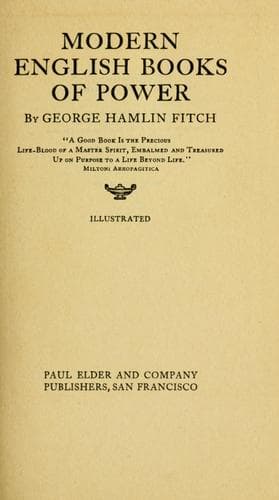
English literature -- 19th century -- History and criticism
Finally Kipling reached London in September, 1889, and after several
months of discouragement, he induced a large publishing house to bring
out _Plain Tales From the Hills_. It scored an immediate success. Like
Byron, the unknown young writer awoke to find himself famous; magazine
editors clamored for his stories at fancy prices and publishers
eagerly sought his work. It may be said to Kipling's credit that he
did not utilize this opportunity to make money out of his sudden
reputation. He doubtless worked over many old sketches, but he put his
best into whatever he gave the public. He married the sister of
Wolcott Balestier, a brilliant American who became very well known in
London as a publishers' agent, and after Balestier's death Kipling
moved to his wife's old home in Brattleboro, Vermont, where he built a
fine country house; but constant trouble with a younger brother of his
wife caused him to abandon this American home and go back to England,
where he set up his lares at Rottingdean, in Surrey. There he has
remained, averaging a book a year, until now he has over twenty-five
large volumes to his credit. In 1907 Kipling was given the Nobel prize
"for the best work of an idealist tendency."
In reading Kipling it is best to begin with some of the tales written
in his early life, for these he has never surpassed in vigor and
interest. Take, for instance, _Without Benefit of Clergy_, _The Man
Who Was_, _The Drums of the Fore and Aft_, _The Man Who Would Be King_
and _Beyond the Pale_. These stories all deal with Anglo-Indian life,
two with the British soldier and the other three with episodes in the
lives of British officials and adventurers.
_The Man Who Would Be King_, the finest of all Kipling's tales of
Anglo-Indian life and adventure, is the story of the fatal ambition of
Daniel Dravot, told by the man who accompanied him into the wildest
part of Afghanistan. Daniel made the natives believe that he was a god
and he could have ruled them as a king had he not foolishly become
enamored of a native beauty. This girl was prompted by a native
soothsayer to bite Dravot in order to decide whether he was a god or
merely human. The blood that she drew on his neck was ample proof of
his spurious claims and the two adventurers were chased for miles
through a wild country. When captured Daniel is forced to walk upon a
bridge, the ropes of which are then cut, and his body is hurled
hundreds of feet down upon the rocks. The story of the survivor, who
escaped after crucifixion, is one of the ghastliest tales in all
literature.
Public-domain text, read in full here on John Shaqi.
Reviews
Reviews
No reviews yet
Be the first to share your thoughts on this work.
Elsewhere in the archive
Join the Discussion
Join the discussion
Sign in to leave a comment or review.
Sign InorCreate an account