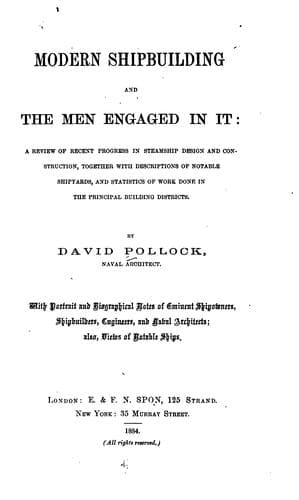
Modern shipbuilding and the men engaged in itPollock, David
History
Modern shipbuilding and the men engaged in it
Pollock, David
Shipbuilding -- Great Britain
The introduction of the double bottom for water ballast in ships,
brought about a great increase in the amount of necessary punching
caused by the numerous man-holes required through the floors and
longitudinals. These man-holes, oval in shape as shown by Fig.
1—of say 18-ins. by 12-ins.—had to be punched all round by the
rivet-punch, and the edges afterwards dressed by hand with a chisel.
To economise work in this connection, need was felt for a machine
which would be capable of punching a man-hole of the ordinary size
out of the thickest plate at one operation. In 1879, at the request
of one of the prominent Clyde firms, Messrs Craig & Donald, the
well-known machine-tool makers of Johnstone, introduced a man-hole
punching machine which cut holes 18-ins. by 12-ins. at the rate of
seven per minute, in such a way that no after-dressing with chisels
was required. This machine, an ordinary eccentric motion one driven
by its own engine, although tested and found capable of cutting an
18-in. by 12-in. hole through a plate 1-in. thick, was superseded
in the yard for which it was made, by another, designed to meet the
requirements of the heaviest type of vessels built on the cellular
principle. This machine—also made by Messrs Craig & Donald, and
five or six of which are now at work in yards on the Clyde and at
Barrow—was capable of piercing a hole 30-ins. by 21-ins. through a
plate ¾-ins. thick, at one operation, and was actuated by hydraulic
power. The ordinary eccentric machine, driven by engine attached, is
still in favour for lighter work, and machines of this type are at
work in several of the East Coast yards capable of punching holes up
to 21-ins. by 15-ins. through plates ¾-ins. thick.
Reverting to the subject of the proportion of material requiring to
be heated before manipulation, it is noteworthy that the employment
of mild steel is a source of economy in this connection as well as
in the many others already noticed. The superior homogeneity and
great ductility of the material favours cold-bending when such an
operation would be fatal to iron. Not only does an economy in labour
result, but incidentally there is a further advantage. Cold-bending
distresses steel less than hot-bending, and the special precautions
so often taken, in the way of annealing, to toughen steel which has
been operated upon when hot, are thus obviated.
Public-domain text, read in full here on John Shaqi.
Reviews
Reviews
No reviews yet
Be the first to share your thoughts on this work.
Elsewhere in the archive
Join the Discussion
Join the discussion
Sign in to leave a comment or review.
Sign InorCreate an account