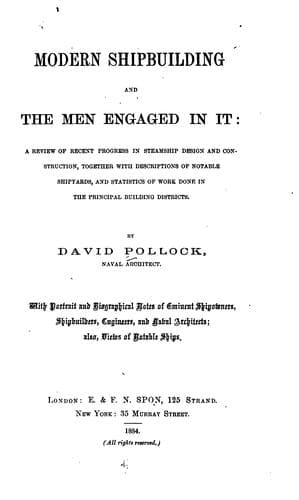
Modern shipbuilding and the men engaged in itPollock, David
History
Modern shipbuilding and the men engaged in it
Pollock, David
Shipbuilding -- Great Britain
A certain proportion of the bottom plates in a ship—_e.g._, those
adjoining the keel—and a few at the stern and elsewhere, have quick
bends and twists which are much more difficult to treat than the
easy and generally uniform curvatures on the plates of the bilge.
The latter are effected in great measure by the “bending rolls”
with the plates perfectly cold, but the former have to be made with
the plate in the heated state. Hydraulic presses have been used
for this purpose for some years, a certain proportion of the work
done being the manipulation of plates while cold. With steel as the
material to be operated upon, these machines are being more and more
utilised in this direction, and their presence in the shipyard, as
in boiler works, is sure to become more and more prevalent. The
operations of the shipyard, in short, have been gaining in exactitude
every year, and have borrowed both in the matters of methods and of
appliances from the marine boiler works, where machine tools are more
conspicuously a feature. Machine tools for riveting, now playing so
important a part in shipyards, first had their utility approved in
boiler shops, and the introduction of improved types of drilling
machines is largely the reflected successes attending them there.
From the foregoing imperfect sketch of the principal directions in
which machine tools used in _preparing material_ for the constructive
stage have been improved or recently introduced, it will be gathered
that hydraulic power in lieu of steam has taken a prominent place in
shipyards. That this is so to a remarkable extent will sufficiently
appear from what follows regarding the appliances used in the work of
_binding the structure_ of vessels. It may, however, be premised that
in several establishments hydraulic pressure has now displaced steam
power in almost all the machine-tools used in the iron departments.
This is so in the case of the Naval Dockyards of Toulon and Brest,
in France, and of the Spanish naval establishments at Ferrol, Cadiz,
&c.; the machinery in the former of which was fully described in
June, 1878, before the Institution of Mechanical Engineers, by M.
Marc Berrier-Fontaine, of the French Navy. The plant and machinery
are by Mr Ralph H. Tweddell, C.E., of Delahay Street, London, whose
numerous inventions and great experience in this special branch of
engineering are well worthy of recognition. The machines comprise
those for punching, shearing, angle cutting, plate bending, and
riveting, and the author referred to is high in his praise of
the superior efficiency and economy of the hydraulic system, as
exemplified in practice. One or two of the leading advantages of
the system may be here summarised. Hydraulic machines do not consume
any power at all during the interval between employment, and the
power can be applied at any moment without preparatory consumption,
and stopped equally quick. No shafting or belting is required, and
Public-domain text, read in full here on John Shaqi.
Reviews
Reviews
No reviews yet
Be the first to share your thoughts on this work.
Elsewhere in the archive
Join the Discussion
Join the discussion
Sign in to leave a comment or review.
Sign InorCreate an account