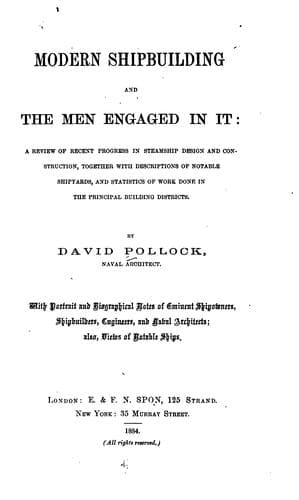
Modern shipbuilding and the men engaged in itPollock, David
History
Modern shipbuilding and the men engaged in it
Pollock, David
Shipbuilding -- Great Britain
Although patent designs for portable hydraulic riveters existed
before 1871, it was not till that year that any form of portable
riveters was applied in practice with any degree of success. Previous
to that year the frames of ships had been riveted by Mr Tweddell’s
stationary hydraulic machines, but a portable riveter invented
by that gentleman in 1871 was then tried, when it was thoroughly
demonstrated that during a working day of 10 hours the machine was
capable of closing 1,000 rivets. Not much encouragement, however,
was received from shipbuilders at the time, owing chiefly to the
fact that the wages for riveting labour was not then a very urgent
question. On a modification of the general plan of working, these
machines being proposed by their inventor in 1876, they received
more cordial recognition from shipbuilders thereafter. It is only,
however, within the past five years or so that portable riveters have
been so extensively introduced into shipbuilding yards. The success
which has attended them during the period leaves no reasonable doubt
as to their ultimate place in every well-appointed shipbuilding
establishment. Already the majority of Clyde shipyards—including all
the larger ones—and most of the yards in the Tyne and Wear districts,
are furnished with hydraulic riveting machines and plant, overtaking
work constantly, efficiently, and with greatly reduced expense, that
is matter of envy in yards not similarly favoured. In most of the
larger Clyde yards the Tweddell machinery and plant are employed; but
in some cases machines introduced by Mr William Arrol, Dalmarnock
Ironworks, Glasgow—chiefly for riveting the frames, beams, &c.—are
used. The Arrol machines work on a similar principle to those of Mr
Tweddell, whose system is practically the only one in use on the Tyne
and the Wear, and at Barrow.
Public-domain text, read in full here on John Shaqi.
Reviews
Reviews
No reviews yet
Be the first to share your thoughts on this work.
Elsewhere in the archive
Join the Discussion
Join the discussion
Sign in to leave a comment or review.
Sign InorCreate an account