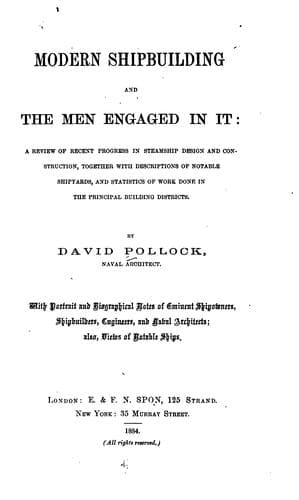
Modern shipbuilding and the men engaged in itPollock, David
History
Modern shipbuilding and the men engaged in it
Pollock, David
Shipbuilding -- Great Britain
The conversion of wood from the absolutely rough state into finished
and finely-surfaced material, ready for immediate use in the interior
of vessels, forms at the present time not an uncommon portion of
the daily work in shipyards well equipped with modern machinery.
This is not only concerned with the commoner woods employed in large
quantities for structural purposes, but also to a considerable
extent with those various ornamental hardwoods entering into the
decorative features. The change of which this is indicative is one
of increased self-dependence and economy formerly not dreamed of
in shipyards, and of improvements at every stage in the machinery
for wood conversion, which are simply wonderful. In circular and
straight saws, planing, moulding, and shaping machines, band and
fret-saw machines, mortising, tenoning, and dove-tailing machines,
and in machines for scraping, sand-papering, and miscellaneous
purposes, not a few modern shipyards reflect the fullest engineering
progress as concerned with wood-working machinery. In planing
machines especially are the labour-saving advantages made apparent.
As illustrating this it may be explained that machines of this
kind in daily use are able to plane a greatly increased breadth of
surface, to work several sides of the wood at one operation, and
at a marvellously accelerated speed as compared with hand work.
Similarly, as regards the formation of mouldings, it may be stated
that a moulding which would take a competent workman some hours to
produce can be completed on a good machine in less than _one minute_.
Many patterns of mouldings and other decorative items now largely
used are thus only possible—commercially if not otherwise—through the
extended employment of machinery. The degree of “finish” now put
upon the plainest features—rendered pecuniarly possible by the use
of machinery—is nowhere so striking as in the scraping of panels and
the sand-papering of large surfaces. In one shipyard the author has
witnessed the scraping of hardwood panels as broad as 30-ins., the
shaving taken off being of marvellous thinness and perfectly uniform
and entire throughout the length and breadth of panel. The surface
left on the panel is beautifully smooth, rendering any after-dressing
with sand paper superfluous, and the shavings have all the appearance
and much of the flexibility of fine paper. In many other ways
that might be instanced, the improvement in machinery is not less
striking, but what has already been given may sufficiently illustrate
the general advance.
Public-domain text, read in full here on John Shaqi.
Reviews
Reviews
No reviews yet
Be the first to share your thoughts on this work.
Elsewhere in the archive
Join the Discussion
Join the discussion
Sign in to leave a comment or review.
Sign InorCreate an account