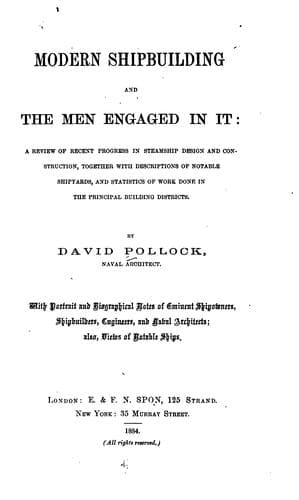
Modern shipbuilding and the men engaged in itPollock, David
History
Modern shipbuilding and the men engaged in it
Pollock, David
Shipbuilding -- Great Britain
Since having commenced shipbuilding operations, Messrs J. &
G. Thomson have placed as many as 200 vessels in the water,
representing an aggregate of 300,000 tons, and a gross capital
value of about £7,500,000. The position, therefore, that Clydebank
yard takes amongst the shipbuilding establishments of the United
Kingdom is certainly in the very front rank. The general manager
of the extensive works is Mr J. P. Wilson, a gentleman of extended
experience, who has before held similar posts, but none more
onerous and exacting. Amongst other of the responsible officials at
Clydebank of whom mention should be made Mr J. H. Biles, the firm’s
naval designer, occupies an important position and shares in the
credit attaching to successful work.
The three yards selected from the Clyde district have now been
described, and their distinctive features enlarged upon. In passing
to the notices of the yards from other districts, it may be stated
that efforts will be made to avoid repetition in details that are
essentially similar. The notices will be of a still more general
character than those preceding, the only portions where anything
like fullness may occur being those concerned with features which
are not embraced in any of the Clyde yards. The most stupendous and
comprehensive of the works to be noticed are those of:—
PALMERS SHIPBUILDING AND IRON COMPANY, LIMITED, JARROW-ON-TYNE.
Palmers Shipbuilding and Iron Company, Limited, have their works at
Jarrow-on-Tyne, about four miles from the sea. The works embrace
both banks of the river Tyne, cover nearly 100 acres of land, and
employ about 7,000 persons. They were first commenced in 1851
by Mr Charles Mark Palmer, the present M.P. for North Durham,
distinguished for the active part he has taken and continues to
take in merchant shipping legislation. In 1865 the works were made
into a limited company, Mr Palmer becoming chairman. It is a saying
in Jarrow, with reference to these gigantic works, that the raw
ironstone is taken in at the one end and launched from the other
in the form of iron steamships, fitted complete with all their
machinery, to carry on a large share of the world’s commerce.
However much this may appear the exaggerated utterance of native
pride, it must be declared to be a literal truth. The works include
within themselves the entire range of operations, from the raising
and smelting of the ironstone to the complete equipment of iron,
steam and sailing vessels of all sizes. The ore itself, raised at
the rate of 1,000 tons per day, is brought round by sea from the
Company’s own mines at Port Mulgrave, near Whitby, in Yorkshire,
and is lifted from the river wharf at the works up to the railway
level, along an inclined plane worked by a stationary engine. Coke
and coal come into the works from Marley Hill and other collieries
in Durham and Northumberland, by the Pontop and Jarrow Railway. The
Public-domain text, read in full here on John Shaqi.
Reviews
Reviews
No reviews yet
Be the first to share your thoughts on this work.
Elsewhere in the archive
Join the Discussion
Join the discussion
Sign in to leave a comment or review.
Sign InorCreate an account