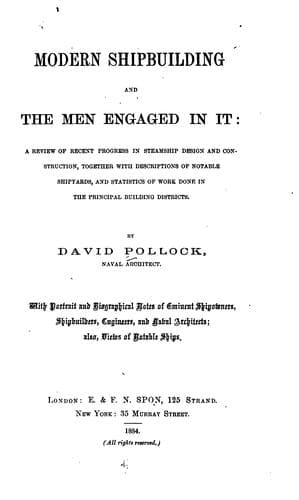
Modern shipbuilding and the men engaged in itPollock, David
History
Modern shipbuilding and the men engaged in it
Pollock, David
Shipbuilding -- Great Britain
coke is discharged into a hopper capable of holding about 1,500
tons, from the bottom of which the blast furnace barrows are filled
through sliding doors, dispensing with manual labour. The four
blast furnaces are 85 feet high, 24 feet diameter at the boshes,
and 10 feet in the hearth. They are capable of producing over 2,000
tons of pig per week, of which more than one-half is used in the
Company’s works. The blast is heated to about 1,500° Fahr. in eight
“Whitewell” hot air fire-brick stoves of the newest pattern, and
there are eighteen kilns for calcining the Cleveland ironstone. The
rolling mill forge comprises eighty puddling furnaces, producing
over 1,000 tons of puddled bars weekly; which, again, are rolled
into plates and angle bars of the largest and smallest sizes used
in the trade. There are two forge engines with 36-inch cylinders,
one of 4 feet and the other of 5 feet stroke, each driving a roll
train and four pairs of 22-inch rolls. There are two plate mills
and ten mill furnaces, producing about 1,200 tons of finished
boiler and ship plates weekly. Each mill has two pairs of 24-in.
rolls, reversed by clutch and crabs; a bar mill with two pairs of
rolls, driven by a 24-inch cylinder, produces 120 tons per week;
a fourth mill, with four pairs of rolls, driven by two 30-inch
cylinders, with 4 feet stroke, produces about 300 tons per week of
plates; also a large angle and bar mill, driven by a single engine,
having 36-inch cylinder and 4 feet stroke, capable of rolling the
very largest angles used in the trade. There is also a sheet mill
in the forge. Attached to the rolling mills are shears, circular
saws, punching, and straightening presses, all of the newest
patterns.
The adjoining department is that of the engine works, which is on
the same gigantic scale, and is capable of finishing about forty
pairs of marine engines with their boilers, annually, besides a
proportionate share of replace boilers and repairs. The department
produces its own iron and brass castings and forgings. In the
boiler shop of this department vertical rolls for rolling long
boiler shell plates were first used, and may be seen in operation.
In the year 1882-83, June to June, thirty-six pairs of
engines, of 7,300 nominal and 39,240 indicated horse-power, were
turned out.
Public-domain text, read in full here on John Shaqi.
Reviews
Reviews
No reviews yet
Be the first to share your thoughts on this work.
Elsewhere in the archive
Join the Discussion
Join the discussion
Sign in to leave a comment or review.
Sign InorCreate an account