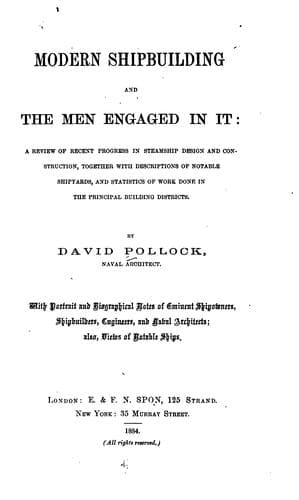
Modern shipbuilding and the men engaged in itPollock, David
History
Modern shipbuilding and the men engaged in it
Pollock, David
Shipbuilding -- Great Britain
The general manager of the gigantic works is Mr John Price,
formerly one of the surveyors and a leading spirit in the
Underwriter’s Registry for Iron Vessels. The following are the
other responsible officials:—Assistant general manager and manager
of rolling mills, Mr F. W. Stoker; secretary, Mr Hew Steele;
shipyard manager, Mr A. Adamson; engine works manager, Mr J. P.
Hall; blast furnaces manager, Mr P. A. Berkeley; blast furnaces
assistant manager, Mr H. T. Allison; mining engineer, Mr A. S.
Palmer.
SIR WM. ARMSTRONG, MITCHELL & CO.’S SHIPBUILDING WORKS,
LOW WALKER AND ELSWICK-ON-TYNE.
The Low Walker yard of this firm was commenced upwards of thirty
years ago by Messrs C. Mitchell & Co., who up to 1883 (when they
amalgamated with Sir W. G. Armstrong & Co., the notable firm of
engineers and artillerists), had built as many as 450 vessels, or
an average of 15 vessels per annum, the average tonnage produced
during the last ten years being 23,000 tons. The yard is situated
about four miles down the Tyne from Newcastle. It consists of
about fifteen acres of ground, and has nine launching berths, but
their arrangement is such that at times there have been as many as
fourteen vessels on the stocks. The establishment is laid out in a
most modern manner. The space occupied by the building slips has a
uniform gradient, and, being perfectly flat laterally, gives the
greatest facility in the movement of bogies. The yard is served by
two complete systems of railways, respectively on the 4 feet 8-in.
and 2 feet 3-in. gauge. The former is in connection with a siding
from the North Eastern Railway, whereby materials and goods can
be brought from all parts of the kingdom, and two locomotives are
constantly employed working the trucks into the yard, one of them
being of very special construction, on Brown’s patent principle,
manufactured by Messrs R. & W. Hawthorn, Newcastle. This locomotive
is combined with a steam crane, the jib of which acts as a lever
with fulcrum, thus dispensing with chains, and which readily swings
right round, depositing the plates on edge into racks arranged on
either side of the railway, from which they can be taken with great
facility by the workmen at the appropriate time.
Public-domain text, read in full here on John Shaqi.
Reviews
Reviews
No reviews yet
Be the first to share your thoughts on this work.
Elsewhere in the archive
Join the Discussion
Join the discussion
Sign in to leave a comment or review.
Sign InorCreate an account