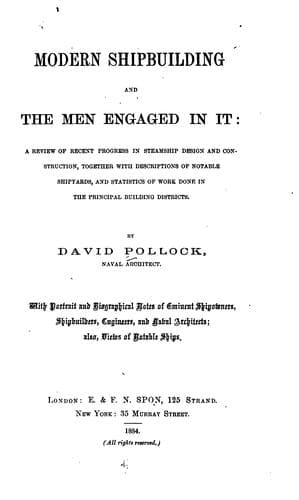
Modern shipbuilding and the men engaged in itPollock, David
History
Modern shipbuilding and the men engaged in it
Pollock, David
Shipbuilding -- Great Britain
About the spring of 1878 matters had not improved in any very
material sense; and the ironworkers insisting on a settlement of
their former claim for an advance, were met by the employers with a
proposal to increase the working hours from 51 per week, as arranged
in 1872, to 54 hours per week, or to reduce the then rate of wages.
The men were not unnaturally averse to the increase of working hours,
and signified their opposition. Subsequently a reduction in wages
of 7½ per cent. was enforced, with the result that the ironworkers
came out on strike for a time. Ultimately in the spring of 1879 a
return to the 54 hours was made. The prevailing great depression
continued well on into the autumn of 1879. In October of that year
the shipbuilding industry experienced an unexpected but very welcome
revival, and an unusually large amount of work came to the Clyde.
The output which in 1879 had fallen to 174,800 tons, now took a
sudden and remarkable jump, the figure for 1880 amounting to no
less than 248,650 tons, affording ample grounds for the belief that
the impetus at the close of 1879 was no mere temporary spurt, but a
solid revival. Subsequent experience has more than justified this
belief. In 1881 the output reached the aggregate of 341,000 tons,
in 1882 it overstepped even this, and the output curve continued
in the ascendant until for the year 1883 the stupendous aggregate
of 419,600 tons was reached. Following the course which accepted
theories regarding industrial activity and depression suggest, and
which actual experience in the past exemplifies, the curve of output
ought still to be in the ascendant, reaching its maximum in 1884, and
thereafter declining. Although the close of the year is still some
distance off, there is already ample reason to believe that this will
not hold good for 1884. This result is after all only very natural
when the most exceptional activity of the past four years, coupled
with the present very unhealthy state of the shipping trade, are
taken into consideration.
* * * * *
The history of iron shipbuilding on the North-East Coast district
does not commence until the year 1840. In March of that year the
_John Garrow_, of Liverpool, a vessel of 800 tons burthen, the first
iron ship seen in the North-East Coast rivers, arrived at Shields,
and caused considerable excitement. A shipbuilding firm at Walker
commenced to use the new material almost immediately, and on the 23rd
of September, 1842, the iron steamer _Prince Albert_ glided from
Walker Slipway into the waters of the Tyne.
Public-domain text, read in full here on John Shaqi.
Reviews
Reviews
No reviews yet
Be the first to share your thoughts on this work.
Elsewhere in the archive
Join the Discussion
Join the discussion
Sign in to leave a comment or review.
Sign InorCreate an account