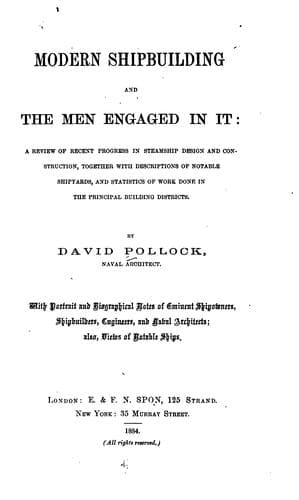
Modern shipbuilding and the men engaged in itPollock, David
History
Modern shipbuilding and the men engaged in it
Pollock, David
Shipbuilding -- Great Britain
In 1865 the output of tonnage was lessened considerably through
what appears to have been but the natural course of commerce in
its reactionary stage. This lessened activity was much aggravated
when 1866 was reached, and in that year a serious interruption to
the trade was caused by a lock-out of the workmen consequent on a
partial strike made to enforce what the employers considered an
unreasonable demand on the part of the men. In 1867 the output was
as low as 108,000 tons, but thereafter it took an upward tendency,
its rise to the previous level being sudden, but thereafter very
gradual, and spread over a number of years. The output kept steadily
improving each year, outreaching former totals, until in 1874 the
curve, or, as it may be called, the output wave, formed a crest of
exceptional altitude. For that year the aggregate output reached
the unprecedented figure of 262,430 tons, a result which made
natural all subsequent references to 1874 as the “big year.” The
year 1875, although showing an increase in the number of vessels
built, yet fell considerably short of 1874 in the matter of tonnage,
thus giving to the output curve a decided downward turn. Matters
continued to grow worse during 1876, and many of the Clyde firms
had painful experiences of “bare poles” until about the beginning
of the year 1877, when a slightly improved state of matters set in.
Then there was a general desire amongst the workmen for an advance
in wages, which ultimately resulted in the great shipwright strike
of midsummer, 1877. This strike, it may be remembered, lasted
twenty-four weeks, and was one of the most determined struggles which
ever took place in this country, both parties having evidently made
up their minds to hold out to the last. The strike culminated in the
general lock-out of workmen in the autumn of the same year, which,
when withdrawn in favour of arbitration as regards the shipwrights,
settled down into a keen fight with the ironworkers. The shipwrights’
claim was settled by arbitration, the umpire (Lord Moncrieff)
deciding in favour of the employers, and the men accordingly resumed
work. The ironworkers’ dispute was likewise a difficult matter to
decide, but ultimately the men resumed work on the understanding that
their claim for an advance upon their wages of 10 per cent. would be
considered six months subsequently. The struggles were exceedingly
costly alike to masters and workmen, one of the results being seen
pretty distinctly in the diminished output of tonnage during 1877.
Public-domain text, read in full here on John Shaqi.
Reviews
Reviews
No reviews yet
Be the first to share your thoughts on this work.
Elsewhere in the archive
Join the Discussion
Join the discussion
Sign in to leave a comment or review.
Sign InorCreate an account