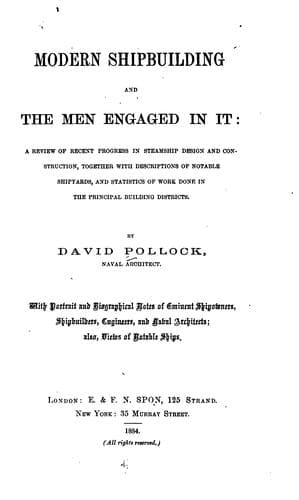
Modern shipbuilding and the men engaged in it — John Shaqi
Modern shipbuilding and the men engaged in itPollock, David
History
Modern shipbuilding and the men engaged in it
Pollock, David
Shipbuilding -- Great Britain
This formed, and still forms in many places, a very common
arrangement for water ballast steamers, although not so inherent a
feature of the vessel’s structure as the continuous-cellular bottom.
In most cases this system is fitted only for part of the length, and
not, like the cellular system, applied throughout the whole length of
the ship. If it was impossible for the Board of Trade to hold by the
contention that cargo might be carried in bottoms of the structural
cellular type, it is equally untenable in the case of bottoms such as
are now referred to. The difference between the two kinds of ballast
bottoms is one merely of construction, and if any one of the two
lends itself to cargo-carrying purposes, it is certainly the cellular
system. The anomaly is sufficiently striking to merit attention, and
in certain districts where the girder system is largely adopted for
medium-sized vessels, it is felt as nothing short of an injustice,
both by shipowners and builders.
The concession or victory won by Messrs Denny removed a serious
hindrance to the spread and general adoption of the water ballast
cellular system. Other Clyde firms at the same time—or at least soon
after the adoption of the system by the Messrs Denny—took the matter
up and independently did much towards the popularisation of the
cellular mode of construction. Speaking in the early part of 1880,
Mr William John, of Lloyd’s Registry, now General Manager with the
Barrow Shipbuilding Company, said:—“At the time Mr Martell read his
paper on water-ballast steamers before the autumn meeting of this
Institution (Naval Architects) at Glasgow, in 1877, there had been
only two or three small steamers built (since Mr Scott Russell’s
early ones) on the longitudinal principle. Now, it is within the
mark to say there are one hundred steamers, built and building,
whose bottoms are constructed on the longitudinal principle, or
what is better described as the cellular system, amounting probably
to 200,000 tons, and it is not outside the bounds of probability
that a very few years will see the majority of merchant steamers
constructed in this manner.” Mr John’s connection with Lloyd’s at
the time, entitled his statements and opinions with regard to the
prevalency and prospects of cellular construction to be accepted with
every assurance, for it is in such Societies as Lloyd’s where the
best consensus of information regarding the extent and tendencies of
particular types of vessels can be obtained. In point of fact, the
intervening period has witnessed, in great measure, a realisation of
Mr John’s forecast. The advantages of a cellular bottom as regards
safety, and for the purpose of ballasting and trimming vessels,
also as meeting the greater need for longitudinal strength caused
by the enormous growth in the size of vessels, have received that
appreciation from shipowners and shipbuilders which is their due.
The practice has accordingly spread, till now, it would not be rash
Public-domain text, read in full here on John Shaqi.
Reviews
Reviews
No reviews yet
Be the first to share your thoughts on this work.
Join the Discussion
Join the discussion
Sign in to leave a comment or review.
Sign InorCreate an account