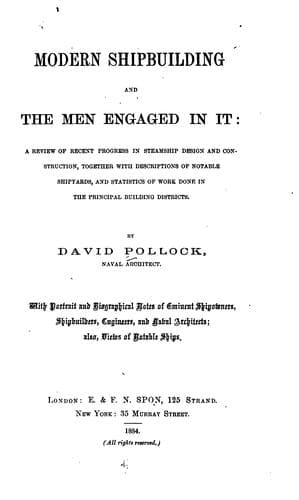
Modern shipbuilding and the men engaged in itPollock, David
History
Modern shipbuilding and the men engaged in it
Pollock, David
Shipbuilding -- Great Britain
[18] An obvious means of dealing approximately with stability, to
which limits of space will not permit more than simple reference,
consists in so manipulating the data obtained by calculation for
known ships that it may be made available, either in the form of
curves or of tables, for determining the stability of proposed
vessels. Methods of accomplishing this may of course vary to suit
the ideas and convenience of designers. A well-arranged system was
brought forward, jointly by Mr F. P. Purvis, head of Messrs W. Denny
& Brothers’ scientific staff, and Mr B. Kindermann, one of his
assistants, in a paper (see list at end of chapter) read before the
Institution of Engineers and Shipbuilders in April last. While the
results exhibited in the paper are immediately applicable to ships of
one particular form, whatever the length, breadth, depth, or draught
may be, this method still requires much development to make it at all
universally applicable.
[19] It is the usual practice to assume vessels to be laden with
homogeneous cargo of such a density as to fill the holds, and for
this condition to estimate the position of centre of gravity to be
used in calculation.
[20] See paper by Mr Kirk “On a Method of Analysing the Forms of
Ships and Determining the Lengths and Angles of Entrance.”—Trans.
Inst. N.A., vol. xii., 1880.
[21] With the view of effecting an economy in time, and to enable
the trials at progressive speeds to be carried out while vessels are
in a lengthened run out to sea, a method has been proposed by Mr J.
H. Biles, naval architect to Messrs J. & G. Thomson, and adopted on
board the vessels tried by that firm, and also experimented with on
some of the vessels turned out by Messrs W. Denny & Bros., by which
the necessity for running with and against the tide on the measured
mile is entirely obviated. The principle of the method is to measure
the time that a certain part of the length of the ship takes to pass
an object thrown from the bows of the vessel well clear of the side.
For full particulars, both of the apparatus employed and of the
results of actual trials by this method compared with trials made on
the measured mile, see paper on “Progressive Speed Trials,” by Mr
Biles, in the Transactions: Institution of Naval Architects, vol.
xxiii., 1882.
[22] A general outline of the operations conducted in Messrs Denny’s
tank will be found in the description of their large works in Chap.
VI. For a detailed account of the _modus operandi_ in the same
establishment, see abstract of a paper delivered in Dumbarton by Mr
E. R. Mumford, of Messrs Denny’s Experimental Staff, printed in the
_Engineer_ for 15th February and the _Steamship_ for 15th February of
the present year.
Public-domain text, read in full here on John Shaqi.
Reviews
Reviews
No reviews yet
Be the first to share your thoughts on this work.
Elsewhere in the archive
Join the Discussion
Join the discussion
Sign in to leave a comment or review.
Sign InorCreate an account